
What Are We Growing Towards? The Messy Middle of Transition
In my last blog I considered the right to be an elder and the right to be listened to. It posed a deliberately difficult question:
Why should anyone listen to their elders?
Age alone does not necessarily confer wisdom. Experience does not automatically become insight, and simply having lived longer does not give any of us an entitlement to tell those following behind us how they should live their lives. So, in this blog, I want to return to the theme of transition and, with that caution applied to the right to be listened to, I want to consider some of the elements that might support our continuing development and some of the things that regularly get in the way.
Because perhaps the interesting question is not simply whether we are getting older. It is:
Are we still growing?
Why growing older should include growing
While reading Trevor Waldock’s The Tap on the Shoulder, I was struck by his reference to Michael Meade and an episode of The Living Myth podcast. Waldock captures the idea in a wonderfully challenging sentence:
“When there is no growth in growing older, ageing becomes all about loss.”
Loss is, of course, part of ageing. People we love disappear. Our bodies change. Careers eventually end. Roles change. Status can diminish. Children build lives of their own. Some opportunities narrow and the amount of time ahead becomes increasingly visible. There is no value in pretending otherwise.
But what if loss is only part of the story? What if, alongside what inevitably diminishes, something else can continue to develop?
Perspective.
Self-understanding.
Curiosity.
Compassion.
Meaning.
Courage.
Wisdom.
Contribution.
Perhaps flourishing in later life isn’t about denying loss.
Perhaps it is about ensuring that loss doesn’t get to tell the whole story.
So what are we growing towards?
This brought me back to a question that has increasingly found its way into my work around flourishing and transition:
What am I growing towards?
Much of earlier adulthood gives us fairly recognisable markers of progress. Education. Career. Relationships. Family. Home. Financial security. Promotion. Expertise. Achievement. We become remarkably accomplished at doing.
But somewhere around midlife, the questions can begin to change. Not for everyone, and certainly not at some predetermined age. But for some of us, something begins to stir. The things that once provided direction may still matter, but somehow they no longer feel sufficient.
The question shifts from:
What do I want to achieve next?
towards:
Who am I becoming?
And eventually:
What am I growing towards?
This is where I think meaning and purpose become particularly important.
Meaning creates depth. Purpose creates direction.
Meaning helps us understand what matters and why.
Purpose begins to translate that understanding into how we might choose to live, work and contribute.
Perhaps this is one of the great opportunities of transition: not to abandon everything that has gone before, but to reconsider our relationship with it.
A simple journey — at least on paper
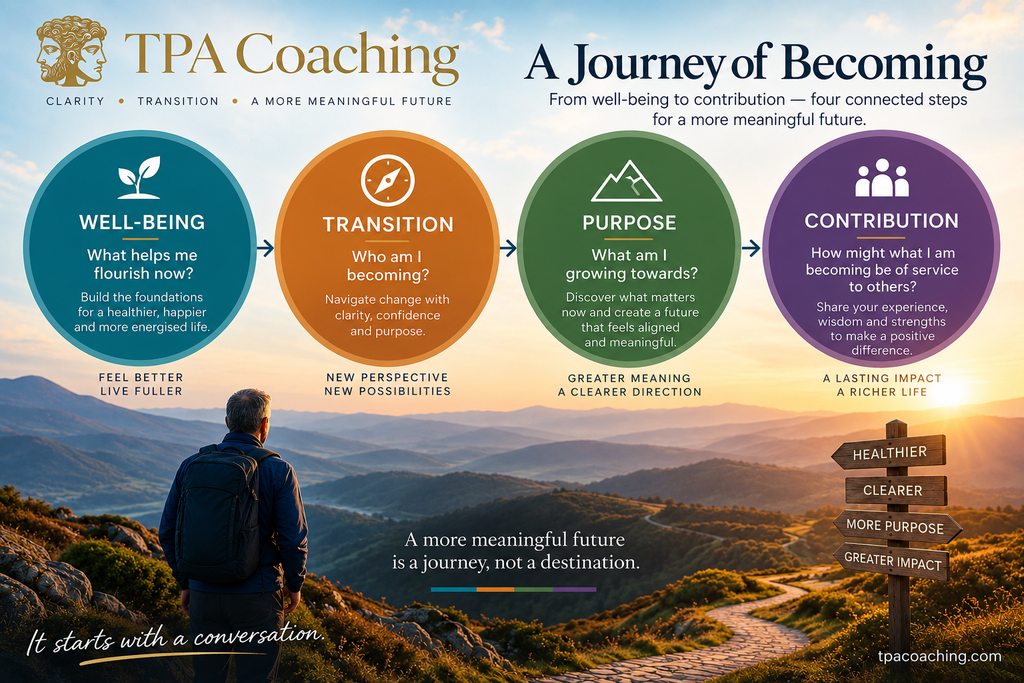
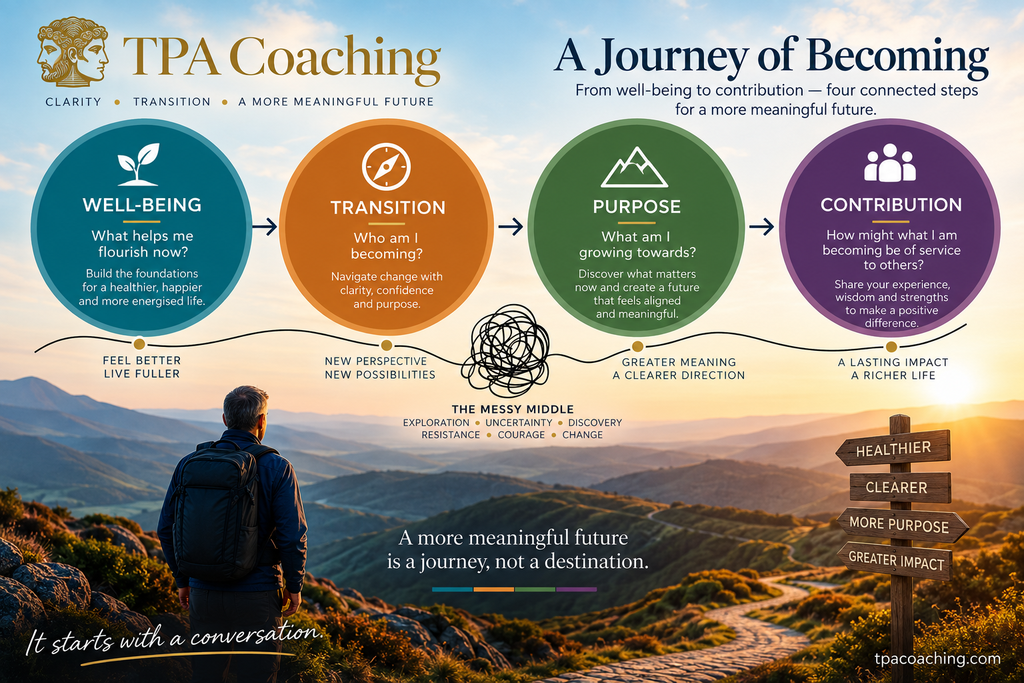
As I have been thinking about my work at TPA Coaching, four connected ideas have emerged:
Well-being → Transition → Purpose → Contribution
Each raises a different question.
Well-being:
What helps me flourish now?
Transition:
Who am I becoming?
Purpose:
What am I growing towards?
Contribution:
How might what I am becoming be of service to others?
On paper it looks wonderfully neat. Four circles. Four questions. A nice arrow connecting one to another. If only human development worked like that. Because the interesting part may not actually be the circles.
It may be what happens in the messy middle between them.
The messy middle
We don’t necessarily leave Well-being on Tuesday and arrive at Transition on Wednesday. We move forwards and backwards. We resist. We question. We become excited and then frightened. We discover something about ourselves and promptly find reasons why we should ignore it. We can desperately want change while simultaneously wanting everything to remain exactly as it is. We can recognise that an old identity no longer fits while being terrified of relinquishing it. We can know that something is stirring without having the slightest idea what it is asking of us. And we can possess decades of experience without knowing what any of it might now be for.
That is transition.
Not simply moving from A to B. But inhabiting, for a while, the uncertainty between them.
Waldock’s diamond, a wonderful metaphor.
This is where another metaphor from Trevor Waldock’s The Tap on the Shoulder becomes particularly useful. In the section he calls “The Invitation,” Waldock uses the metaphor of a diamond. A diamond has different faces. Turn it slightly and something different catches the light. That seems an appropriate metaphor for transition because there may be no single issue to resolve. Different aspects of ourselves become visible depending upon where we are standing and what life is asking of us.
Across this section, Waldock invites us to consider themes including:
Being seen.
Being called.
Recognising your ego identity.
Crystallising your experience.
Facing the unwelcoming proposition.
Awakening perspective.
Growing into love.
Starting the liberating journey.
Developing courage.
I don’t read these as nine boxes that must be ticked. Nor do I see them as a staircase which everyone must climb in the same order. I find the diamond metaphor more interesting than that.
Different faces become important at different moments.
Which face is facing you?
.Perhaps the challenge is being seen. After decades of performing roles — leader, parent, partner, professional, provider, expert — allowing ourselves to be genuinely seen can be surprisingly uncomfortable.
Perhaps we are experiencing the call. The tap on the shoulder. The quiet voice that says: “There must be another way“.
Perhaps we are confronting ego identity. Who am I without my title? Without my organisation? Without being the person with the answers? Without the identity I have spent thirty years constructing?
Perhaps we need to crystallise our experience. Experience alone isn’t necessarily wisdom. We have to stop long enough to examine it. What did I learn? What changed me? What do I now understand that I didn’t understand twenty years ago? What have I been wrong about?
Perhaps we are facing Waldock’s unwelcoming proposition. Because genuine transition usually requires something from us. Something may need to be relinquished such as status, certainty, belonging, a familiar identity, an out of date definition of success.
Perhaps we need an awakening of perspective, an the ability to stand outside some of the assumptions, systems and expectations that have shaped us and ask whether they still serve us.
Perhaps growth begins to become less about achievement and more about love, relationship and connection.
Perhaps we are ready to begin a more liberating journey.
And perhaps we know all of this already but haven’t yet developed the courage to act upon it.
Maybe that is what growth looks like
This takes me back to Michael Meade’s provocation.
“When there is no growth in growing older, ageing becomes all about loss.”
Less time. Less physical capacity. Fewer roles. Fewer possibilities. Eventually, fewer people around us.
But continued development introduces another possibility.
More perspective. Greater self-knowledge. Deeper relationships. Greater discernment. More compassion. Greater acceptance. More freedom from the need to prove ourselves. A clearer sense of what matters. And perhaps a growing desire to contribute.
The first list does not disappear because of the second.
Both can be true.
And perhaps that is a more realistic understanding of flourishing as we grow older.
Not perpetual happiness.
Not pretending we are still 35.
Not desperately trying to hold onto everything we once were.
But continuing to become.
Linking Transition to Flourishing
To give our journey the greatest opportunity to flourish we should not ignore the self, keeping fit as best we can, eating well, sleeping well, socialising and building intrinsic happiness. Each of these will set us in good stead for the journey of transition, to enable us to dig deep and investigate, explore, be curious about what might help us thrive and have purpose and meaning.
In conclusion:
Meaning creates depth. Purpose creates direction.
Meaning and purpose are often used as though they are interchangeable. I increasingly think about them differently.
Meaning creates depth.
It helps us make sense of our experience, relationships, values, successes, failures and the events that have shaped us.
It asks:
What really matters to me now?
Purpose then creates direction.
It asks:
Given what matters, what do I want to do with the life and experience I have?
That direction doesn’t necessarily mean starting a charity, changing career or embarking upon some grand mission.
Purpose can be expressed quietly. Through family. Mentoring. Community. Creativity. Friendship. Service. Teaching. Learning. Leadership. Care.
Sometimes the most profound transition isn’t towards more.
It is towards what matters more.
In my next article I will share where I fell the value of working with a trusted friend, a thinking partner and maybe a coach can support the investigation and journey through transition.