

The Science of Human Flourishing: 10 Daily Practices That Transform Wellbeing

The Modern Wellbeing Challenge
We live in a world of constant stimulation, increasing pressure, digital overload, and fragmented attention.
Many people are successful on paper yet exhausted internally.
They are productive, but disconnected. Busy, but not fulfilled. Connected digitally, yet emotionally depleted.
The truth is that sustainable wellbeing is not built through occasional breakthroughs. It is built through consistent daily practices that align the mind, body, emotions, and values.
This is where modern wellbeing science becomes incredibly powerful.
Research from Positive Psychology, neuroscience, behavioural science, and embodied leadership increasingly points toward the same conclusion:
Human flourishing occurs when psychological wellbeing and physical intelligence work together.
At TPA Coaching, we describe this as the intersection between:
- The PERMA framework developed by Martin Seligman
- Claire Dale’s Physical Intelligence model
- Evidence-based behavioural practices
- Nervous system regulation
- Meaning-driven performance
The result is a more integrated model of wellbeing:
A Thriving Mind
A Resilient Body
A Purposeful Life
The PERMA + Physical Intelligence Hybrid Framework
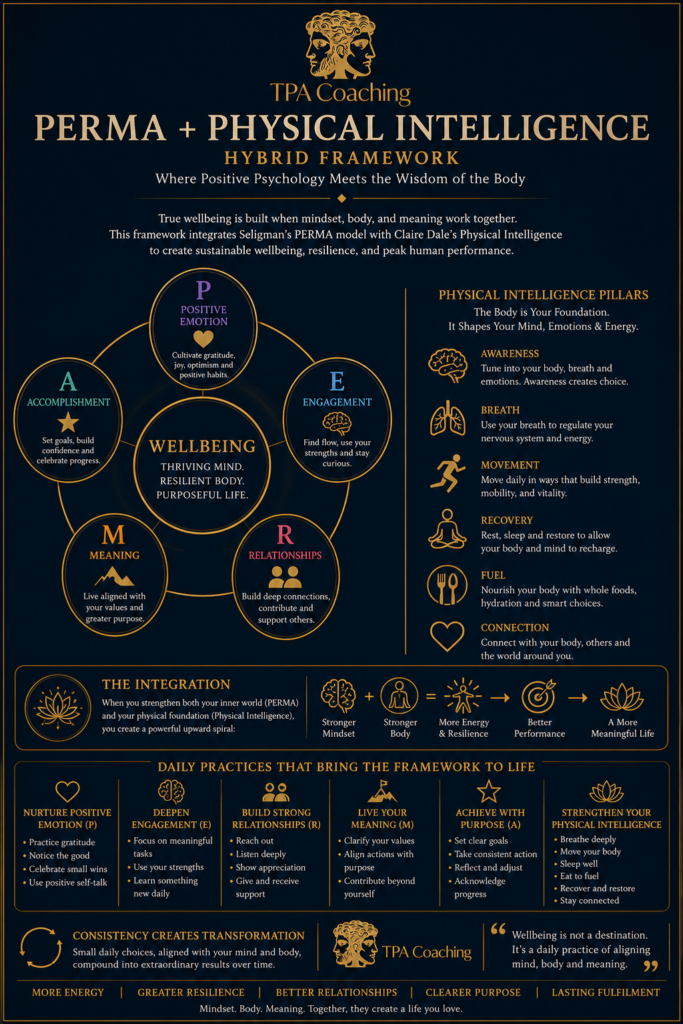
Martin Seligman’s PERMA model identifies five key dimensions of wellbeing:
- Positive Emotion
- Engagement
- Relationships
- Meaning
- Accomplishment
Claire Dale’s Physical Intelligence framework reminds us that our physiology shapes our psychology.
How we breathe. How we move. How we recover. How we regulate stress.
All of these influence performance, resilience, leadership, and emotional wellbeing.
Together, these models create a more complete understanding of human flourishing.
Wellbeing is not simply mindset. It is an integrated system involving:
- body
- brain
- behaviour
- meaning
- relationships
- emotional regulation
- recovery
- purpose
The good news?
Small daily practices can create profound transformation over time.
Below are the 10 most powerful evidence-based practices that consistently support wellbeing, resilience, and high performance.
1. Sleep Enough and Well
Why It Matters
Sleep is the foundation of emotional regulation, cognitive performance, stress resilience, and physical recovery.
Without quality sleep:
- decision-making declines
- emotional reactivity increases
- stress tolerance decreases
- focus and creativity suffer
- wellbeing becomes significantly harder to sustain
Research consistently shows that sleep quality influences nearly every aspect of psychological functioning.
The Physical Intelligence Perspective
Recovery is performance. The body and brain require restoration to function optimally.
Daily Practice
- Aim for 7–9 hours of sleep
- Keep a consistent sleep schedule
- Reduce screen exposure before bed
- Prioritise morning sunlight exposure
- Create calming evening routines
2. Move Your Body Daily
Why It Matters
Movement is one of the most effective natural interventions for improving mood, reducing stress, and increasing energy.
Physical activity supports:
- emotional regulation
- cognitive performance
- resilience
- confidence
- long-term health
Exercise is increasingly recognised as both a mental health and performance tool.
The Physical Intelligence Perspective
Movement changes chemistry.
The body was designed for motion. When we move regularly, we regulate stress more effectively and access higher levels of mental clarity and vitality.
Daily Practice
Find forms of movement you genuinely enjoy
Walk daily
Strength train regularly
Stretch or mobilise
Take movement breaks during work
3. Practice Gratitude
Why It Matters
Gratitude shifts attention away from scarcity and threat.
It helps train the brain to notice what is working rather than constantly scanning for what is wrong.
Research links gratitude practices with:
- improved wellbeing
- greater optimism
- stronger relationships
- reduced stress
- improved sleep quality
The Positive Psychology Perspective
Martin Seligman’s “Three Good Things” exercise remains one of the most researched positive psychology interventions.
Daily Practice
Each evening, write down:
- Three things that went well
- Why they happened
Small moments matter.
4. Build Meaningful Relationships
Why It Matters
Human connection is one of the strongest predictors of happiness, wellbeing, and even longevity.
Relationships shape:
- emotional resilience
- belonging
- motivation
- purpose
- wellbeing
Strong relationships create emotional safety.
The PERMA Perspective
Relationships are central to flourishing. Humans are wired for connection.
Daily Practice
- Listen deeply
- Be fully present in conversations
- Express appreciation
- Reach out intentionally
- Prioritise meaningful interactions over superficial connection
5. Practice Mindfulness
Why It Matters
Mindfulness helps regulate attention and reduce mental overload.
In a distracted world, the ability to return to the present moment is becoming increasingly valuable.
Mindfulness supports:
- stress reduction
- emotional regulation
- focus
- self-awareness
- calm decision-making
The Integration Perspective
Awareness creates choice.
The more aware we become of our thoughts, emotions, and physiological state, the more intentional we can become.
Daily Practice
- Practice mindful breathing
- Spend 10 minutes in meditation
- Reduce multitasking
- Build moments of pause into your day
6. Breathe Deeply and Often
Why It Matters
Breathing directly influences the nervous system.
Shallow breathing often reinforces stress. Slow, controlled breathing helps activate calm, focus, and emotional balance.
Breath is one of the fastest ways to influence internal state.
The Physical Intelligence Perspective
The body is not separate from emotion. Physiology influences psychology.
Daily Practice
Try:
- Box breathing
- Physiological sighs
- Slow nasal breathing
- 4–6 breathing patterns
Even 60 seconds of intentional breathing can reset the nervous system.
7. Spend Time in Nature
Why It Matters
Nature restores attention and reduces stress.
Modern life often disconnects people from natural rhythms, recovery, and stillness.
Research increasingly shows that nature exposure improves:
- mood
- emotional wellbeing
- stress regulation
- cognitive restoration
The Integration Perspective
Nature reconnects us to perspective.
It slows the nervous system and creates space for reflection.
Daily Practice
- Walk outdoors
- Spend time near green spaces
- Get natural sunlight exposure
- Reduce device use while outside
- Create moments of quiet observation
8. Focus on What You Can Control
Why It Matters
Much of modern stress comes from directing energy toward things outside our control.
When people focus excessively on uncertainty, external validation, or uncontrollable outcomes, anxiety increases.
Resilient individuals focus energy where they have influence.
The Positive Psychology Perspective
Optimism is not blind positivity. It is the ability to take constructive action where possible.
Daily Practice
Ask yourself:
- What can I influence today?
- What action is available to me right now?
- Where should my energy go?
9. Reflect and Journal
Why It Matters
Reflection helps transform experience into insight.
Journaling supports:
- emotional processing
- self-awareness
- clarity
- perspective
- intentional growth
Without reflection, people often repeat patterns unconsciously.
The Integration Perspective
Awareness precedes transformation.
Daily Practice
Useful prompts include:
- What energised me today?
- What drained me?
- What mattered most?
- What did I learn?
- How did I show up?
10. Live in Alignment With Your Values
Why It Matters
One of the greatest causes of internal conflict is misalignment between values and behaviour.
People experience greater wellbeing when their daily actions reflect what truly matters to them.
Purpose is not found once. It is expressed repeatedly through small daily choices.
The PERMA Perspective
Meaning creates depth. Purpose creates direction.
Daily Practice
Ask:
- What matters most to me?
- Did my actions reflect my values today?
- Am I building the life I actually want?
Conclusion
Small Practices. Big Transformation.
The most important insight from wellbeing science is surprisingly simple:
Transformation is rarely the result of one dramatic moment.
It is the result of repeated daily actions.
Small habits compound.
A single mindful breath. A meaningful conversation. A short walk. An intentional pause. A moment of gratitude.
Over time, these practices reshape:
- mindset
- resilience
- emotional wellbeing
- relationships
- energy
- purpose
- performance
At TPA Coaching, we believe sustainable wellbeing emerges when:
Mindset, body, behaviour, and meaning align.
This is not about perfection. It is about consistency.
One practice. One choice. One day at a time.
References
Martin Seligman — PERMA Model & Positive Psychology
Claire Dale & Patricia Peyton — Physical Intelligence
Harvard Adult Development Study
Positive Psychology Research Institute
Behavioural Science & Neuroscience Research
Mindfulness & Stress Regulation Studies