

The Missing Foundation of Flourishing: Why Feeling Safe Comes Before Growing
Over the past few years, I have been exploring what it really means to flourish.
That journey has led me through positive psychology, PERMA, the VIA Character Strengths, physical vitality, the science of happiness, healthy ageing, and what I have come to call The Human Flourishing Architecture™. Throughout this exploration, one idea has remained constant: lasting change rarely comes from dramatic transformations. Instead, it grows through small, intentional actions repeated consistently over time.
These “little and often” moments have become a central theme of my work.
Recently, however, I found myself reflecting on something that was missing.
As I pondered my flourishing theory, I realised that much of what I had developed explained how we can flourish. It offered practical habits, coaching conversations, reflective practices, and evidence-based frameworks that help people move towards healthier and more meaningful lives.
But I began to ask myself a deeper question.
Why do some people embrace these opportunities for change while others, despite their best intentions, struggle to take even the first step?
The answer, I believe, lies much deeper than mindset alone.
Going Deeper before we go wider
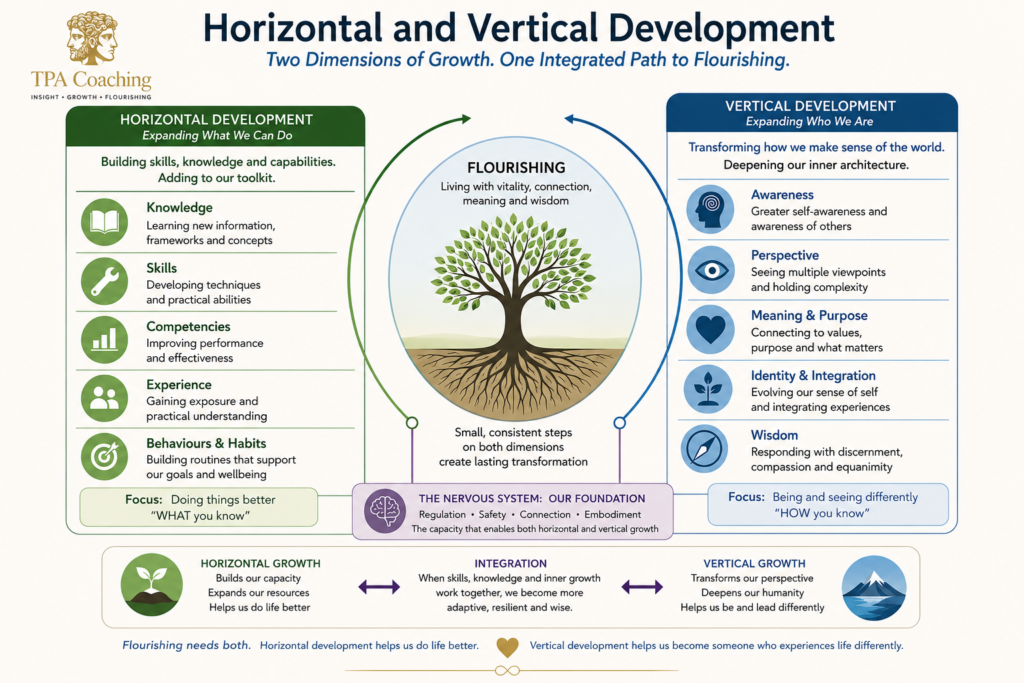
My exploration of horizontal and vertical development reinforced this thinking. Horizontal development gives us new knowledge, new skills and new techniques. Vertical development, by contrast, changes how we make sense of ourselves and the world around us. It transforms not only what we know, but who we become.
As I continued this journey, I found myself drawn towards the work of Dr Stephen Porges and his ground breaking Polyvagal Theory, and to the wonderfully practical work of Deb Dana, particularly her book Anchored.
Anchoring
Deb Dana’s work resonates so powerfully. She uses the metaphor of an anchor in her book of the same name and suggests that:
‘Once we know how our nervous system works, we can work with it,’
‘We can learn to access an embodied, biological resource that is always present, available, and there to guide us toward well-being.’
An aggressive email from your boss, or a fight with your partner – these situations aren’t life-or-death, yet our bodies may react as if they are.
She argues that we can train our nervous system to stop overreacting, and start responding to the world with greater safety and ease, if we know how.
In Anchored, Deb Dana shares a down-to-earth presentation of Polyvagal Theory, then brings the science to life with practical, everyday tools.
Dana helps us master the skills to become more aware of our nervous system moment to moment, and change the way you respond to the great and small challenges of life.
What struck me immediately was how naturally these ideas complemented everything I had been exploring.
Polyvagal Theory reminds us that we are not simply thinking beings trying to make good decisions. We are biological beings whose nervous systems are constantly asking one fundamental question:
“Am I safe?”
Long before our conscious mind begins to analyse a situation, our nervous system has already started to interpret the world around us.
A critical email from a manager.
An unexpected life transition.
A difficult conversation.
Retirement.
Redundancy.
Relationship difficulties.
Illness.
Loss.
To our nervous system, these experiences can feel like threats.
To our nervous system, these experiences can feel like threats, even when our rational mind knows they are not life-threatening. When this happens, our body shifts into protection before our mind has the opportunity to choose curiosity, creativity or connection.
This insight has fundamentally changed the way I think about flourishing.
Perhaps flourishing does not begin with positive thinking.
Perhaps it begins with helping our nervous system recognise that we are safe.
When our nervous system feels safe, remarkable things begin to happen.
We become more curious.
We think more clearly.
We regulate our emotions more effectively.
We become more open to learning.
We reconnect with other people.
We regain our creativity.
We become willing to explore rather than simply survive.
In many ways, this feels like the missing foundation beneath everything I have previously written.
Positive psychology teaches us the importance of positive emotions, relationships, engagement, meaning and accomplishment.
Character strengths help us understand what is best within us.
The science of healthy ageing encourages us to invest in our physical, emotional, social and intellectual wellbeing.
The DOES model reminds us how everyday activities influence our neurochemistry.
Yet all of these approaches become significantly easier when our nervous system feels regulated enough to move from protection towards connection.
This is where Deb Dana’s work resonates so powerfully.
She does not invite us to fight our nervous system or to “fix” ourselves.
Instead, she encourages us to become curious.
To notice.
To listen.
To understand.
To befriend the very system that has spent our entire lives trying to keep us safe.
That feels deeply aligned with coaching.
Linked to Coaching
As coaches, we rarely create change by giving better advice. We create change by helping people notice what they have not yet noticed. Awareness creates choice, and choice creates possibility.
Perhaps the same is true of flourishing.
Instead of constantly asking ourselves, “What should I do next?”, we might first ask, “What is my nervous system telling me right now?”
That simple shift can change everything.
It also reinforces my belief that flourishing is never achieved through one grand gesture.
It grows through small, repeatable moments of regulation.
A slower breath before replying to an email.
A short walk outside.
A meaningful conversation with someone we trust.
A moment of gratitude.
A pause before reacting.
A reminder that we are safe enough to be curious.
These tiny acts may seem insignificant in isolation, yet together they begin to reshape how we experience ourselves and the world around us.
Perhaps this is what flourishing really looks like.
Not the absence of challenge.
Not constant happiness.
But the growing capacity to return, again and again, to a place where we feel sufficiently safe to learn, connect, contribute and grow.
The Architecture of Flourishing
When I developed The Human Flourishing Architecture™, one observation kept returning.
People rarely flourish because of one single factor.
They flourish because many small behaviours begin supporting one another.
A short walk improves energy.
More energy improves mood.
Better mood strengthens relationships.
Stronger relationships reinforce meaning.
Greater meaning encourages healthier choices.
Healthier choices improve sleep.
Better sleep increases resilience.
Resilience improves decision-making.
Before long, one small behaviour has quietly influenced every part of life.
Flourishing behaves much more like an ecosystem than a checklist.
Everything connects.
To conclude
As my own Human Flourishing Architecture™ continues to evolve, I now see nervous system regulation not as another pillar to add alongside the others, but as the foundation upon which they all stand.
When we feel safe, we become available to flourish.
And perhaps the journey towards flourishing still begins exactly where I have always believed it does
with one small step.
Then another.
Little and often.
Because sometimes the smallest step we take is not moving forward at all.
Sometimes it is simply finding our anchor.