

The Goods Life or the Good Life?
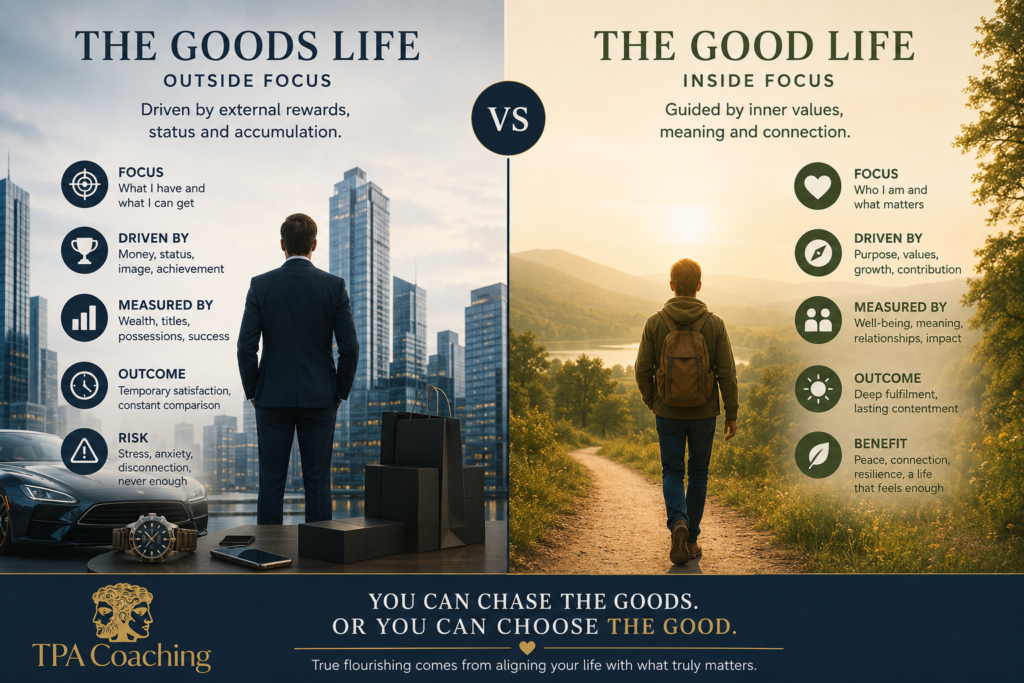
What are we really chasing?
For much of our lives we are encouraged to believe that success looks a certain way.
A bigger salary.
A nicer house.
A better car.
The latest technology.
More status.
More recognition.
Modern society has become remarkably good at convincing us that happiness can be bought, accumulated or displayed.
Psychologist Tim Kasser challenged this assumption in his influential work The High Price of Materialism (2002). He distinguishes between what he calls the goods life and the good life—two very different ways of living.
The Goods Life
The goods life is centred on extrinsic goals.
These are goals that depend on external rewards or approval:
- Wealth
- Status
- Image
- Prestige
- Power
- Being admired by others
There is nothing inherently wrong with money or ambition. Financial security matters, and achievement can be deeply satisfying. The difficulty arises when these become the primary measure of a life well lived.
Research consistently shows that people whose lives are dominated by materialistic values often report:
- lower life satisfaction
- higher anxiety
- poorer relationships
- greater stress
- less vitality
- reduced psychological wellbeing
Why?
Because external rewards rarely stay satisfying for long. There is always another promotion, another purchase, another comparison, another target.
The finish line keeps moving.
The Good Life
The good life looks remarkably different.
Rather than focusing on what we own, it focuses on who we become.
Instead of chasing external validation, it nurtures intrinsic values such as:
- meaningful relationships
- personal growth
- contribution
- health
- compassion
- learning
- purpose
- connection with something larger than ourselves
These are the experiences that positive psychology repeatedly associates with enduring wellbeing.
Interestingly, many of these cannot be purchased.
They are cultivated.
Why this matters.
As a coach, I often meet people who appear successful from the outside.
They have built careers.
Raised families.
Accumulated possessions.
Achieved professional recognition.
Yet something still feels missing. Their diary is full. Their life feels empty.
This is where Kasser’s distinction becomes so powerful.
The question is not whether we have achieved enough.
The question is whether we have invested in the things that genuinely allow us to flourish.
Building a Flourishing Life
Within my own work on The Human Flourishing Architecture™, I see this as the difference between constructing an impressive building and creating a home.
The outer structure may look successful, but unless the foundations are built on purpose, relationships, physical vitality, character strengths, emotional wellbeing and meaningful contribution, the structure can feel strangely hollow.
This is why flourishing requires more than achievement.
It asks us to pay attention to the inner architecture of our lives.
Research from positive psychology, including the work of Martin Seligman, Edward Deci and Richard Ryan, Sonja Lyubomirsky, and Tim Kasser, increasingly points in the same direction.
Long-term wellbeing comes less from what we accumulate and more from the quality of our relationships, the meaning we create, the strengths we develop and the contribution we make.
Perhaps the real measure of success is not how much we own, but how fully we live.
As Kasser reminds us, there is an important difference between having many goods and living a genuinely good life.
That distinction may be one of the most valuable questions we ever ask ourselves.
Why Do We Chase the Goods Life?
If pursuing the good life appears to bring greater wellbeing, why are so many of us drawn towards the goods life?
Tim Kasser suggests that the answer lies not simply within us, but around us.
From childhood onwards we are immersed in cultures that continually reinforce the message that success is visible, measurable and purchasable.
Success becomes something we can display.
Our society has become remarkably effective at encouraging us to ask:
- What do you own?
- What do you earn?
- What car do you drive?
- Where do you holiday?
- How many followers do you have?
- What title sits on your business card?
These are not accidental questions.
They are continually reinforced by powerful social institutions.
The Economic Perspective
Modern economies depend upon continual consumption.
Businesses innovate.
Marketers create aspiration.
Advertising creates desire.
There is nothing inherently wrong with this, it has undoubtedly contributed to rising living standards, medical advances and remarkable technological innovation.
Yet the economic system also has an understandable incentive to encourage us to believe that satisfaction lies just one purchase away.
Psychologists sometimes refer to this as the hedonic treadmill.
The excitement of the new phone, new car or new promotion fades surprisingly quickly, requiring the next acquisition to recreate the same feeling.
Consumption becomes less about meeting needs and more about maintaining identity.
The Social Perspective
Human beings are social creatures. We naturally compare ourselves with others. Today those comparisons occur twenty-four hours a day.
Social media rarely shows ordinary life. Instead it presents carefully curated versions of success.
Holidays become more exotic.
Homes become more beautiful.
Careers appear effortless.
Relationships appear perfect.
Psychologists call this social comparison, first described by Leon Festinger, and extensive research suggests that upward comparison can undermine wellbeing, particularly when it becomes habitual.
The question subtly shifts from:
“Am I living well?”
to
“Am I doing as well as everyone else?”
The Political perspective
Kasser also argues that public policy can unintentionally reinforce extrinsic values. Governments are understandably concerned with economic growth, employment and productivity.
Gross Domestic Product (GDP) has long been one of the dominant measures of national success.
Yet GDP tells us remarkably little about:
- psychological wellbeing
- community connection
- loneliness
- purpose
- trust
- mental health
- quality of relationships
A country can become wealthier while many of its citizens become more anxious, isolated or disconnected.
This has led economists and psychologists such as Richard Layard to argue that societies should measure success not simply through economic output but through wellbeing.
Similarly, the Organisation for Economic Co-operation and Development Better Life Index and the United Nations World Happiness Report attempt to broaden our understanding of what makes societies flourish.
None of This Means Wealth Is Bad
This is an important distinction.
Kasser is not suggesting we should reject ambition, neither is he arguing that money does not matter. Financial security is strongly associated with reduced stress, improved health and greater opportunity.
The issue is not having wealth.
The issue is allowing wealth to become our identity.
There is a profound difference between:
Using possessions to support a meaningful life
and
Using life to accumulate possessions.
Returning to the Good Life
Perhaps this explains why so many people experience what appears, on the surface, to be successful lives yet still describe a persistent feeling that something is missing.
Achievement alone cannot satisfy our deeper psychological needs.
This is where my own work on The Human Flourishing Architecture™ increasingly aligns with Kasser’s thinking.
Flourishing is not anti-success.
It is about broadening our definition of success.
It recognises that human beings need more than financial capital.
We also need:
- emotional capital
- relational capital
- physical vitality
- character strengths
- purpose
- contribution
- psychological safety
- opportunities for continual growth.
When these are present, success becomes something we experience internally rather than simply something others observe externally.