

Flourishing Is Not Something We Do Alone
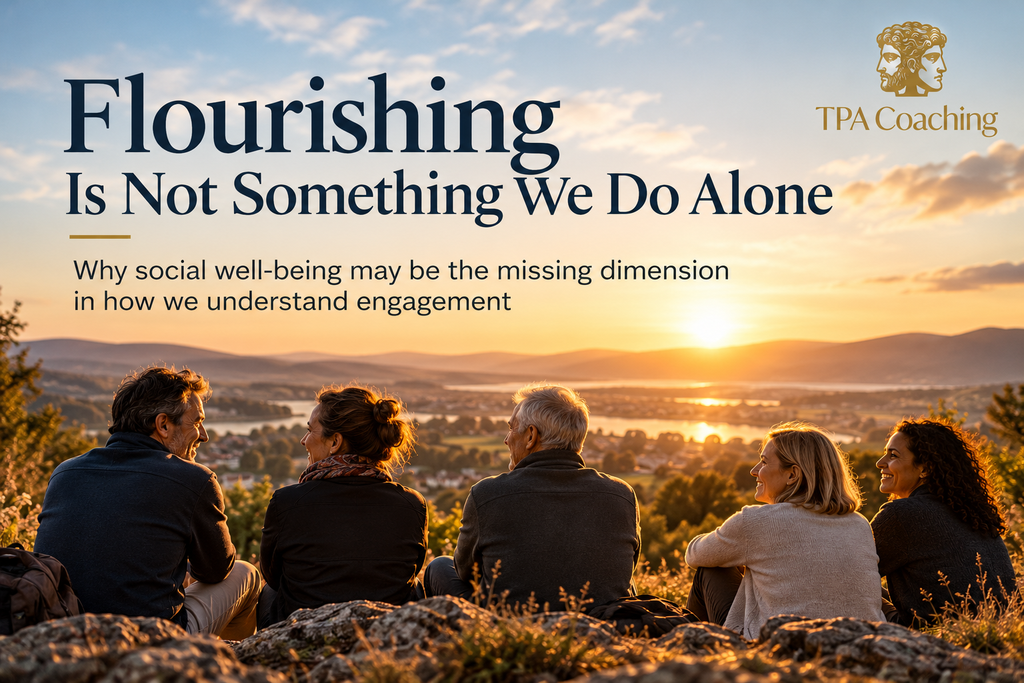
Why social well-being may be the missing dimension in how we understand engagement
Much of my recent writing has explored what it means to flourish, particularly as we navigate the transitions that accompany midlife and growing older.
I have become increasingly interested in the difference between simply feeling good about life and developing our capacity to live well. It is a distinction that has led me to explore positive psychology, character strengths, resilience, emotional regulation and the relationship between our minds and bodies.
These ideas have gradually informed what I describe as my Human Flourishing Architecture™ — an evolving framework that brings together different aspects of human development and well-being.
At its heart is a relatively simple proposition: flourishing is not merely a desirable psychological state. It is something we can develop our capacity for, through how we think, feel, behave, learn and engage with life.
But there is something important missing from this description.
We do not flourish in isolation.
And perhaps understanding how we engage with the world around us is just as important as understanding what happens within us.
What do we mean by engagement?
In Martin Seligman’s PERMA model of well-being, engagement is one of five essential elements of flourishing, alongside positive emotions, relationships, meaning and accomplishment.
Engagement is closely associated with the work of Mihaly Csikszentmihalyi and his concept of flow, those experiences in which we become so absorbed in an activity that our sense of time and self-consciousness temporarily recede. We might experience this through our work, creative pursuits, sport, learning or any activity that sufficiently challenges and absorbs us.
It is a compelling idea.
But I have been wondering whether engagement deserves a wider interpretation. What if engagement is not simply about how absorbed we become in what we are doing, but also about how we participate in the world around us?
How connected do we feel to society? Do we understand the world we inhabit? Do we believe it has the potential to improve? Do we feel accepted, and do we believe that we have something worthwhile to contribute?
These questions move us beyond engagement as an individual psychological experience and towards something more social.
And this is where I encountered the work of sociologist and psychologist Corey Keyes.
Corey Keyes and the social dimensions of well-being
In 1998, Corey Lee M. Keyes published a paper entitled Social Well-Being in the journal Social Psychology Quarterly.
Keyes argued that our understanding of well-being had become overly focused on individuals and their private psychological experiences.
We had developed ways of considering whether people were happy, satisfied with life, functioning effectively and experiencing personal growth.
But what about their relationship with society?
Keyes proposed that social well-being should be understood as a distinct aspect of positive functioning, concerned with how individuals perceive the quality of their relationship with their communities and the wider social world.
He identified five dimensions.
Social coherence: Does the world around me make sense?
This concerns our ability to understand and make sense of the social world. It is not about agreeing with everything happening around us, but about perceiving some degree of meaning, order and intelligibility in society.
Social actualization: Do I believe society can grow and improve?
This reflects our confidence in the potential of society and its institutions to develop positively. It involves a sense of hope about our collective future.
Social integration: Do I feel that I belong?
Integration concerns our sense of connection with communities and the wider society. It is the experience of being part of something rather than feeling isolated or excluded.
Social acceptance: How do I regard other people?
Interestingly, this is not primarily about whether other people accept us. It concerns our own willingness to accept others, recognise their positive qualities and maintain a broadly trusting view of humanity.
Social contribution: Do I have something worthwhile to offer?
This is our sense that we have value to others and that our participation makes a meaningful contribution to society.
Taken together, these five dimensions offer something rather different from the more familiar measures of personal happiness and psychological well-being. They encourage us to consider not simply how well we are doing within ourselves, but how well we are participating in the world around us.
And I think this distinction matters enormously.
Social flourishing: the detail of engagement?
As I have reflected on Keyes’ work, I have begun to see social flourishing as providing something of the missing detail in our understanding of engagement.
I do not mean that Keyes was attempting to redefine Seligman’s concept of engagement. His work preceded the development of PERMA and addressed a different theoretical question. Nor do I believe that social well-being is simply another name for engagement.
But I do think that bringing the two perspectives together reveals something important.
Engagement, as understood through flow, describes the quality of our absorption in an experience.
Social well-being describes the quality of our perceived relationship with the social world.
One concerns how fully we become involved in an activity. The other concerns how meaningfully we experience ourselves as part of society.
Perhaps flourishing requires us to consider both the depth of our personal engagement and the breadth of our social participation.
We might become deeply engaged in our work, our hobbies or our personal development while simultaneously becoming increasingly disconnected from the wider world.
Equally, we might belong to numerous communities and social networks without necessarily experiencing the psychological absorption and challenge associated with flow.
These are different experiences, but both may contribute to a flourishing life.
For me, this provides a compelling reason to retain social flourishing as a distinct component of my Human Flourishing Architecture™. It is not intended to replace engagement within PERMA, but to extend the conversation about what engagement in life might mean.
Why this becomes particularly important during transition
Consider someone approaching the later stages of their working life. They may have spent thirty or forty years developing their professional identity, building relationships, solving problems, leading others and contributing to organisations. Much of their sense of belonging and usefulness may have become associated with their professional role.
Then something changes.
Perhaps they retire, step away from leadership, experience redundancy or simply begin to question whether the work they have been doing still provides the meaning it once did.
We often describe this as an identity transition. And it certainly can be.
But through Keyes’ framework, we can see that something else may be happening.
Their sense of social integration may be changing as professional relationships and networks disappear.
Their sense of social contribution may be challenged as the expertise they once offered is no longer actively sought.
Their social coherence may be disrupted as the world they understood begins to feel unfamiliar.
Their confidence in society’s future may diminish, particularly if they experience ageism, exclusion or a perceived loss of influence.
And their acceptance of others may be tested as frustration or disappointment shapes how they interpret the behaviour of younger generations or changing institutions.
Suddenly, the transition is not simply about who they are becoming. It is also about how they are finding their place in the world again.
This is an important distinction. Because someone can possess considerable psychological resilience, emotional intelligence and personal strengths while still experiencing a profound loss of social connection or usefulness.
Perhaps this helps explain why some transitions remain difficult even when we appear to have all the personal resources necessary to navigate them.
From personal growth to social contribution
In previous articles, I have explored the idea that growing older should not necessarily mean that our opportunities for growth diminish. I have drawn upon Michael Meade’s reflections on ageing and the importance of ensuring that something within us continues to grow as we become older.
But Keyes introduces another dimension to this enquiry.
What happens to that growth?
Is it simply something we accumulate for ourselves, or can it become something that contributes to the lives of others?
This connects with Erik Erikson’s concept of generativity; the developmental concern with contributing to future generations and supporting something beyond our immediate personal interests.
It also connects with my growing interest in the concept of eldership. I have previously questioned whether growing older automatically gives us the right to be listened to. My conclusion was that experience alone does not necessarily become wisdom, and wisdom is not something we can simply claim for ourselves.
But perhaps Keyes helps us consider another possibility.
The value of our continued development may lie not simply in what we know, but in how that knowledge becomes useful to others.
We may discover new ways of contributing through mentoring, volunteering, supporting younger generations, participating in our communities or simply becoming more present and available to those around us. Not because we need to demonstrate our worth through constant activity. But because having a sense that our lives matter to others can itself be an important aspect of well-being.
And perhaps social contribution is not simply something that follows from flourishing.
Perhaps it is also one of the ways in which flourishing develops.
Adding social flourishing to the Human Flourishing Architecture™
My Human Flourishing Architecture™ has been developing around several complementary perspectives.
PERMA provides an understanding of positive emotions, engagement, relationships, meaning and accomplishment.
VIA character strengths offer a language for recognising and developing the qualities we bring to our lives.
Physical Intelligence draws attention to the relationship between our psychological experiences and our physiological functioning.
Resilience helps us understand how we respond to challenge, uncertainty and change. I increasingly see these as complementary resources for developing our capacity to flourish.
Keyes’ work encourages me to add another component: Social Flourishing.
For the moment, I want to retain this as a distinct element rather than attempting to absorb it into the existing framework. Why?Because it encourages us to ask questions that the other components do not necessarily address directly.
Not simply whether we have positive relationships, but whether we feel part of society.
Not simply whether we experience personal meaning, but whether we believe our participation matters to others.
Not simply whether we are optimistic about our own future, but whether we have confidence in the potential of the world around us.
And not simply whether we are engaged in fulfilling activities, but whether we are meaningfully engaged in the wider human experience.
I am beginning to think of social flourishing as the detail of engagement with the world.
It offers a way of examining the quality of that engagement through five distinct perspectives: coherence, actualization, integration, acceptance and contribution.
This is not yet a finished model, and I would not suggest that Keyes’ research validates my particular architecture. Rather, it provides an established theoretical foundation upon which to develop this additional dimension.
That distinction matters, particularly if we are to build a framework that is both practically useful and academically credible.
Flourishing as something we develop together
There is a danger in some approaches to well-being that we place too much responsibility upon the individual.
We encourage people to become more resilient, regulate their emotions, develop positive thinking, practise gratitude and cultivate their strengths.
All potentially valuable activities.
But what happens when the difficulty is not simply within the individual?
What happens when people feel excluded, overlooked, disconnected or unable to find meaningful opportunities to contribute?
Surely flourishing cannot be understood entirely as an individual responsibility.
Our social environments, communities, organisations and institutions also create, or constrain, the conditions in which people can flourish.
This is particularly relevant to the challenges facing people at both ends of working life.
Young people seeking belonging, opportunity and a meaningful place in society. Older people seeking continued relevance, participation and opportunities to contribute. Different stages of life, perhaps, but with some remarkably similar social questions.
Where do I belong?
Does my participation matter?
Is there a place for me in the world?
And can I imagine a future in which I have something worthwhile to offer?
These are not simply questions of happiness.
They are questions of social flourishing.
A final reflection
I began this exploration by asking whether engagement might be understood more broadly than our capacity to become absorbed in an activity. Keyes’ work has not changed my appreciation of flow or the importance of personal engagement. But it has encouraged me to look beyond the individual.
To consider the quality of our participation in society, our sense of belonging, our willingness to accept others and our belief that we have something worthwhile to contribute.
And perhaps, particularly during midlife and later-life transitions, these are questions we should be asking more often.
Because developing our capacity to flourish may not simply involve becoming more psychologically resourceful, emotionally balanced or personally fulfilled.
It may also involve rediscovering how we belong, where we can contribute and how our continued growth can become meaningful to others.
What if flourishing is not simply about becoming more fully ourselves, but about becoming more fully engaged with the world to which we belong?
Perhaps that is where social flourishing begins.
References
Csikszentmihalyi, M. (1990). Flow: The psychology of optimal experience. Harper & Row.
Erikson, E. H. (1950). Childhood and society. W. W. Norton.
Keyes, C. L. M. (1998). Social well-being. Social Psychology Quarterly, 61(2), 121–140. https://doi.org/10.2307/2787065
Keyes, C. L. M. (2002). The mental health continuum: From languishing to flourishing in life. Journal of Health and Social Behavior, 43(2), 207–222. https://doi.org/10.2307/3090197
Seligman, M. E. P. (2011). Flourish: A visionary new understanding of happiness and well-being. Free Press.
Summary of TPA Coaching.
At TPA Coaching, I work with people exploring midlife transition, well-being, changing identities and the search for meaning and purpose. If something is stirring and you would value a thinking partner, perhaps an initial conversation is a useful place to begin.
Get in touch at tim@tpacoaching.com