

Flourishing Is Not Just About Feeling Good: Widening My Perspective on Positive Psychology
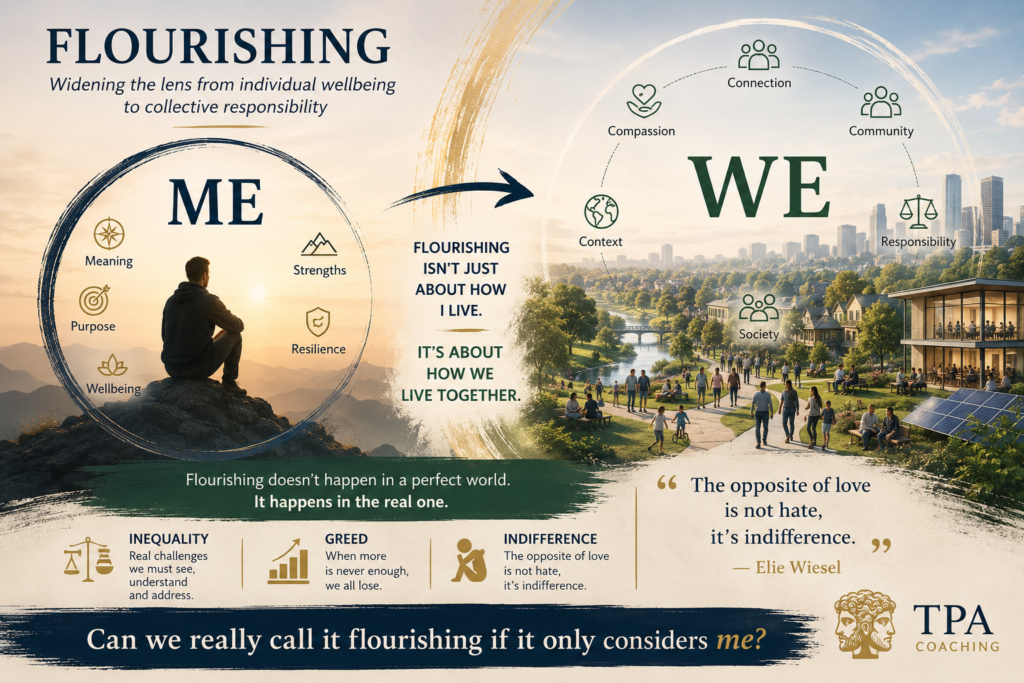
Over recent months I have been writing, reading and thinking increasingly about human flourishing.
Positive Psychology has inevitably played an important part in that exploration. Seligman’s PERMA model, the work of Deci and Ryan on motivation, Csikszentmihalyi on attention and flow, Kasser on intrinsic and extrinsic values, and the wider literature around meaning, resilience, relationships and wellbeing have all influenced my thinking.
But the more I explore flourishing, the less comfortable I become with the idea that it can be understood solely by looking at the individual.
Perhaps flourishing requires us to ask a bigger question:
Can I truly flourish independently of the world around me?
That question became much more prominent for me while reading Carol Ryff’s challenging paper, Positive Psychology: Looking Back and Looking Forward.
Ryff is not particularly gentle with Positive Psychology. Indeed, she describes herself as someone who has always remained somewhat outside the movement. Her central concern is that human life cannot easily be separated into the positive and the negative. Life contains what she describes, drawing on Rilke, as the “beauty and terror of life.”
I rather like that. Because flourishing surely cannot mean removing the difficult parts of being human. It must somehow mean learning how to live fully with them.
The danger of a WEIRD understanding of flourishing
One of Ryff’s criticisms particularly caught my attention.
Much Positive Psychology research, like a significant amount of psychological research more generally, has relied upon relatively homogeneous populations. This is sometimes described as the WEIRD problem:
Western
Educated
Industrialised
Rich
Democratic
Ryff argues that minorities and socioeconomically disadvantaged people have frequently been underrepresented, despite evidence that wellbeing varies according to age, socioeconomic status, race, gender and culture. She highlights the striking finding that only around 2% of Positive Psychology interventions examined had been conducted with vulnerable groups or in multicultural contexts.
That creates an uncomfortable question.
Whose flourishing are we actually describing?
It is relatively easy to talk about purpose, strengths, accomplishment, autonomy and personal growth when we assume that people have sufficient resources and freedom to pursue them.
But what happens when they don’t?
Poverty matters. Inequality matters. Discrimination matters. Culture matters. Employment conditions matter. Community matters.
The systems in which we live matter.
And perhaps this is where my own thinking is beginning to shift.
From “me” to “we”
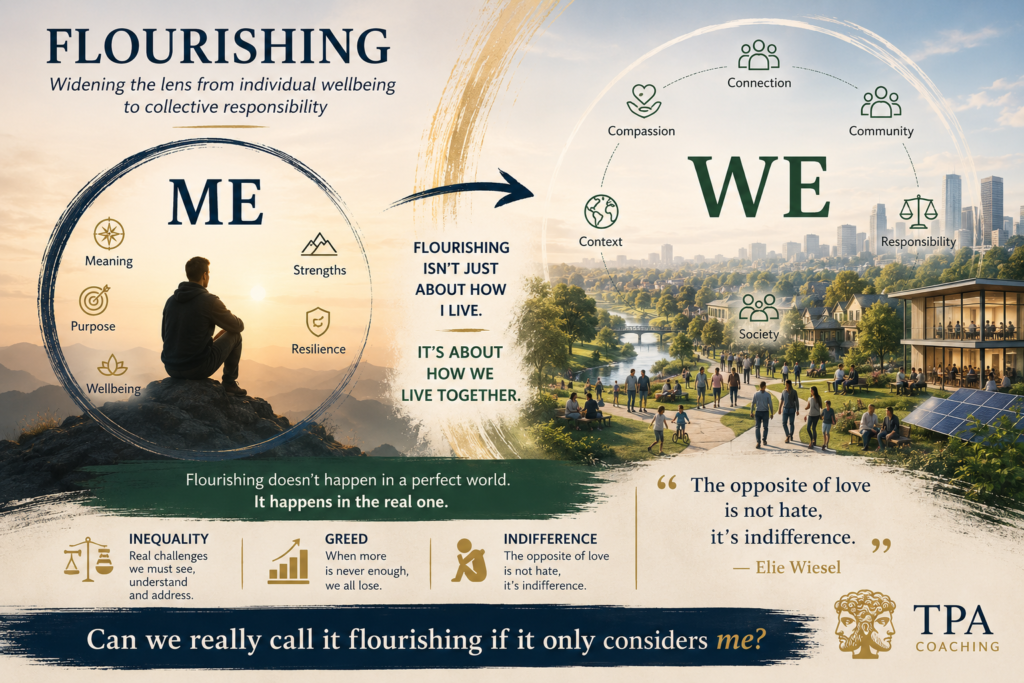
Much of my earlier exploration of flourishing has inevitably started with the person.
What am I paying attention to? What gives my life meaning? What relationships nourish me? What strengths am I using? How am I responding to change? What choices am I making?
I still believe these are important questions. But they are no longer enough.
Ryff highlights calls within Positive Psychology itself to move beyond the individual towards groups, organisations and wider systems, taking historical, social, cultural and institutional context more seriously.
That resonates strongly with the direction my thinking is taking.
Perhaps flourishing has at least two dimensions:
How am I living well?
and
How does the way I live contribute to others being able to live well?
That second question changes things. Flourishing becomes not simply psychological, but relational, systemic and perhaps even moral.
The neglected negatives
Ryff then takes her argument somewhere I wasn’t expecting.
Positive Psychology was partly founded on the argument that psychology had become overly concerned with pathology, weakness and damage. Ryff suggests that in turning towards the positive, psychology may have overlooked another important category altogether.
She calls these the “neglected negatives.”
Among them she identifies greed and indifference, alongside stupidity and the more complex emotion of anger. Her concern is that the wellbeing of some people may actually be compromised by the priorities and actions of others.
This is an important challenge to an individualised understanding of flourishing.
We can encourage someone to become more resilient. We can help them practise gratitude. We can encourage mindfulness, optimism, purpose and strengths.
But what if the environment to which we are helping them adapt is itself part of the problem? There is a danger that wellbeing becomes about helping individuals cope better with circumstances that perhaps ought to change.
That feels particularly relevant to organisations. A workplace cannot simply teach resilience while ignoring excessive workloads. It cannot promote mindfulness while tolerating destructive leadership. It cannot talk about purpose while rewarding behaviours driven primarily by self-interest. And it cannot place responsibility for wellbeing entirely upon the individual while ignoring the system surrounding them.
Greed and the “goods life”
This also connects powerfully with my recent exploration of Tim Kasser’s distinction between the “goods life” and the “good life.”
Ryff specifically draws upon Kasser and Ryan’s work showing that people primarily motivated by extrinsic aspirations such as financial success tend to experience poorer wellbeing and adjustment than those oriented towards less materialistic values.
This takes the discussion beyond simply owning too much stuff.
Greed is about enough never quite being enough.
More money. More status. More recognition. More power. More consumption. More success.
The interesting question for flourishing therefore becomes not merely what do I want?, but:
What is enough?
And perhaps, eventually:
What might I release so that there is more space for what actually matters?
And then there is indifference
Ryff’s section on indifference is remarkably short.
Instead, she largely hands the argument to Holocaust survivor and Nobel Laureate Elie Wiesel:
“The opposite of love is not hate, it’s indifference.”
Ryff argues that indifference to the suffering of others deserves serious psychological attention: where does it come from, how is it enacted, and what are its consequences?
This stopped me.
Because if flourishing is purely about my wellbeing, my meaning, my relationships, my accomplishment and my potential, it is theoretically possible for me to flourish while remaining indifferent to you. And I’m increasingly unsure that I would call that flourishing at all.
Perhaps compassion is not simply an attractive consequence of flourishing. Perhaps it is one of its conditions.
Flourishing needs the whole of life
None of this makes me want to discard Positive Psychology. Quite the opposite. It makes me want to broaden it.
I still see enormous value in understanding strengths, positive emotions, relationships, meaning, accomplishment, resilience, hope, attention and purpose. But flourishing cannot become an endless pursuit of positivity.
Sadness can tell us something.
Anger can tell us something.
Discomfort can tell us something.
Indeed, earlier work reviewed by Ryff argues that negative states can themselves contribute towards flourishing, challenging simplistic divisions between optimism and pessimism, freedom and restriction, forgiveness and anger, happiness and sadness.
Perhaps flourishing is not about feeling good. Perhaps it is about becoming increasingly capable of living well with the whole of life.
The beauty and the terror.
The gain and the loss.
The certainty and the uncertainty.
The individual and the collective.
My thinking is changing
And maybe that is what I am enjoying most about this exploration.
I don’t want my developing thinking about Human Flourishing to become a fixed model into which I simply fit every new piece of research.
I want the research to challenge it.
My exploration of Polyvagal Theory has encouraged me to think more deeply about the body and our need for safety and connection.
Kasser has made me think more carefully about intrinsic and extrinsic values.
My exploration of adult development and life’s transitions has drawn me towards identity, meaning and becoming.
And Ryff is now pushing me further — from the individual towards the systemic and societal.
Perhaps flourishing sits somewhere in the relationship between all of these.
Self and others.
Inner world and outer world.
Agency and context.
Wellbeing and suffering.
Individual development and collective responsibility.
So my question is becoming less:
“How do I flourish?”
and increasingly:
“How do we create lives, relationships, organisations and communities in which flourishing becomes more possible — not only for ourselves, but for others?”
That feels like a much bigger enquiry.
And, increasingly, I think it is the one worth pursuing.
References
Ryff, C. D. (2022). Positive Psychology: Looking Back and Looking Forward. Frontiers in Psychology, 13, 840062.