
Becoming an Elder: Have We Earned the Right to Be Heard?
From ageing to wisdom, from achievement to transcendence and from having answers to becoming curious again
I ended my last blog with an intention to explore more deeply does everyone inevitably become an elder simply by growing older? I will do so within this blog but I would like to explore an additional tension I am feeling.
Why should younger people listen to us?
I have become increasingly fascinated by the idea of eldership. Trevor Waldock’s writing about transitions, thresholds and becoming an elder has particularly caught my attention. It seems to connect with much of what I have been exploring around midlife, flourishing and that curious sense that can emerge later in life that what brought us here may not necessarily be what we need for what comes next.
There is something deeply attractive about the proposition.Perhaps there comes a point when life becomes less about what we can acquire, achieve or prove and more about what we can contribute.
Experience might become wisdom. Achievement might become meaning. Success might become service. And self-actualisation might eventually open towards something beyond the self: transcendence.
I love that possibility, and yet something about it also makes me uncomfortable, because if eldership is a developmental destination, who actually gets there? Does everybody? And, perhaps more provocatively:
Why should the generations following us have any interest in what we have to say?
The possibility of becoming
Part of my conflict comes from my own approach to coaching and human development.
Carl Rogers has significantly influenced the way I think about people. At the heart of his person-centred philosophy is the actualising tendency: the proposition that human beings possess an inherent orientation towards growth, development and becoming.
That resonates deeply with me.
It also connects with Tim Gallwey’s work and the belief that potential exists within people, while interference, both internal and external, can prevent its expression.It means that when someone sits opposite me in a coaching conversation, I don’t want to begin by deciding the limits of who that person might become.
There is something wonderfully optimistic about that. And it makes Waldock’s invitation towards eldership attractive, why shouldn’t that possibility be available to everyone?
But then I encounter Robert Kegan,and the comfortable answer becomes less comfortable.
Development doesn’t necessarily follow ageing
Kegan’s work on adult development reminds us that getting older and developing are not the same thing. Human beings can develop increasingly complex ways of making meaning, culminating in what Kegan describes as the self-transforming mind. But there is no inevitability about reaching it.
We can accumulate decades of experience without fundamentally changing the way we understand ourselves or the world around us and that creates an important distinction. Age gives us experience but it doesn’t necessarily give us wisdom.
We can experience the same things repeatedly while reinforcing the same assumptions. We can become extremely experienced at being the person we have always been but wisdom seems to require something more.
It requires reflection, curiosity, humility. It requires the willingness to examine what we once regarded as certain and perhaps the courage to let some of it go. So perhaps the possibility of eldership can be universal without eldership itself being inevitable.
The invitation may be available to everyone. The willingness or capacity to cross the threshold may not be.
Beyond becoming ourselves
This is where Abraham Maslow becomes particularly interesting. Most of us encountered Maslow through the familiar hierarchy of needs, usually represented as a pyramid culminating in self-actualisation. Becoming more fully who we are capable of becoming.
But Maslow’s later thinking moved beyond self-actualisation towards self-transcendence: the possibility that our development can eventually orientate us towards something beyond ourselves. I find the distinction compelling.
Perhaps self-actualisation asks:
Who am I capable of becoming?
Self-transcendence asks:
What might I now give myself to that is larger than me?
And eldership might ask:
How might who I have become now be placed in service of those who follow?
That final question feels particularly important, but it introduces another, far less comfortable one.
Why should younger people listen to us?
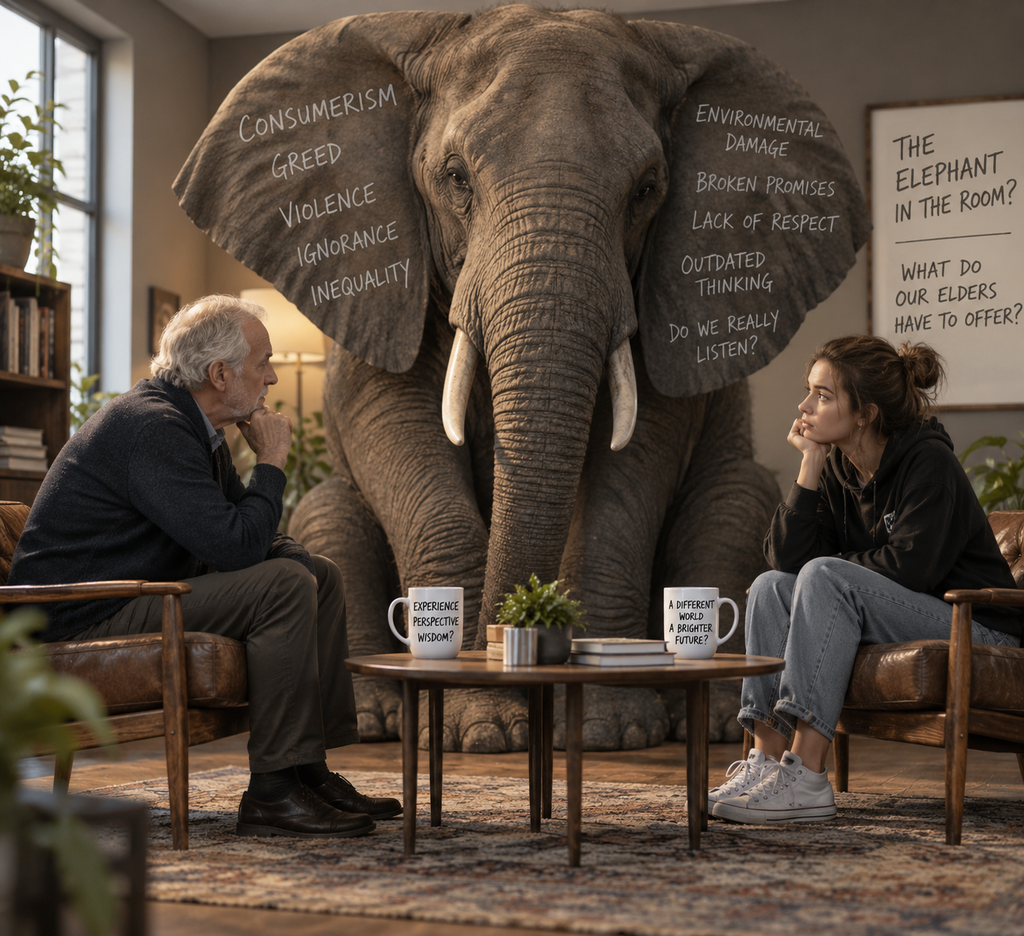
There is an elephant in the room whenever my generation starts talking about becoming elders.
Why should younger generations want our wisdom?
Many of us have grown up and prospered during an extraordinary period of consumerism. We have participated in cultures where success has frequently been associated with accumulation. Wanting more; wanting something bigger; wanting something faster; expecting constant growth; developing our status; having more stuff.
And younger generations might reasonably look at the world they are inheriting and question just how wise their elders have actually been.
They see environmental degradation and climate anxiety. Extraordinary wealth alongside persistent inequality. Conflict and violence despite decades of supposed human progress. Individualism frequently overwhelming community. Consumption confused with flourishing. And extraordinary technological connectivity accompanied, paradoxically, by loneliness, division and disconnection.
Responsibility for these things cannot simply be laid at the feet of one generation. That would be far too simplistic. But neither can we ignore the uncomfortable question.
What exactly are we proposing to pass on?
Do we really get to arrive in later life, declare ourselves elders and expect younger people to listen? Probably not. Perhaps eldership isn’t something we can claim, maybe it is something we have to earn.
When age, experience and wisdom become confused
This question became even more interesting for me while reading Sharon Strickland-Clark’s emerging work, Mentoring Across Difference. Sharon is a Fellow Mentor with the ABM and she raised an interesting debate with her peers when she released a discussion document relating to mentoring differences. One aspect of difference is generational although her article widens the debate, I would like to consider the aspect of age and eldership and the challenge I have often battled with.
Sharon challenges a traditional assumption about mentoring: that wisdom travels primarily from the more experienced person towards the less experienced one. Today’s multigenerational workplace makes that increasingly difficult to sustain.
As she observes:
“Age, knowledge, authority and experience no longer align neatly.”
An experienced leader might possess decades of organisational memory, pattern recognition, relationship knowledge and understanding of consequences. Someone thirty years younger might simultaneously possess knowledge of technologies, emerging cultures, changing social expectations or new ways of thinking that sit almost entirely outside that leader’s experience. Experience, therefore, wears many faces.
And that presents a fascinating challenge to eldership.
Age is not experience.
Experience is not necessarily wisdom.
And wisdom is not the exclusive property of age.
Experience has a shadow
There is another idea in Sharon’s work that stopped me. She asks mentors to recognise that their greatest strengths can also have shadows. Responsibility can become control. Care can become rescue and of course, experience can become certainty.
That feels particularly relevant to eldership. The very experience that qualifies us to contribute can eventually prevent us from learning.
We begin saying: “In my experience…” “We’ve tried that before…” “What you need to understand…” “When you’ve been around as long as I have…”
Our experience stops being something we offer and becomes something we defend. Perhaps that is precisely where wisdom starts becoming dogma, and perhaps it helps explain Kegan’s developmental challenge.
The self-transforming person isn’t simply someone who has developed a sophisticated understanding of the world. They are increasingly able to stand outside their own system of meaning and recognise that it, too, is incomplete.
What an extraordinary capability that might be for an elder:
To possess considerable experience without needing that experience to be right.
Memory and possibility
This is where Sharon offers an idea that I think profoundly enriches Waldock’s concept of eldership.
She describes those who have travelled furthest as carrying memory, pattern recognition and an understanding of consequence, while those arriving later carry proximity to a world that is still forming. Neither, she argues, can safely inherit the future alone.
I find that beautiful.
Perhaps the relationship between generations shouldn’t be:
Old → Young
Wisdom transmitted downwards.
Perhaps it should look more like:
Memory ↔ Possibility
The elder can say:
“I understand something about how we got here.“
And the younger person can respond:
“I understand something about the world that is emerging.“
Then they might ask one another:
What can we see together that neither of us can see alone?
That feels much closer to the kind of eldership I want to explore.
Perhaps younger people shouldn’t listen to us
Which leads me towards a deliberately provocative thought.
Perhaps younger people shouldn’t automatically listen to their elders.
Perhaps we need to earn their attention, not through age or status and not by reminding them how much we have experienced.
But through the quality of our presence. This can be achieved by curiosity, humility, through acknowledging our mistakes and through recognising the systems from which some of us benefited have also created consequences that others will inherit. And, crucially, by demonstrating that their perspective is capable of changing ours, because what kind of elder enters an intergenerational conversation expecting everyone except themselves to learn?
There is a wonderful paradox here.
Perhaps one of the requirements of becoming an elder is the willingness to become a student again. To become curious about artificial intelligence rather than simply suspicious of it.
To listen to changing attitudes towards work, gender, identity, community and relationships without immediately judging them against the norms through which we grew up.
To understand why younger people might question assumptions about career, hierarchy, consumption, home ownership and endless economic growth that previous generations often accepted.
To listen when they ask difficult questions about inequality and the environment they are inheriting.
In conclusion:
So who gets to become an elder?
Perhaps I have been asking the wrong question. Maybe an elder isn’t someone who has accumulated enough experience to have the answers.
Perhaps an elder is someone whose experience has taught them to become less certain about their answers and more thoughtful about their questions. Someone able to carry wisdom without needing to impose it. Someone willing to remain a student while becoming a guide.
Someone capable of saying to a younger person:
“I have travelled further along the road, but that doesn’t mean I know where your road should lead.“
“Let me offer you what I have learned.“
“And let me remain open to what you might teach me.“
Perhaps that is the form of eldership our times require.
Not wisdom travelling from old to young. But creating the conditions in which memory and possibility can meet.
And perhaps the ultimate test of whether we have become elders isn’t whether younger generations are willing to listen to us.
It is whether, after all these years of accumulating experience, we are still willing to listen to them.
References and influences
Waldock, Trevor — work on thresholds, transitions and eldership, including To Plant a Walnut Tree: How to Create a Fruitful Legacy by Using Your Experience.
Rogers, Carl R. — person-centred theory, the actualising tendency and the human capacity for growth and becoming.
Gallwey, W. Timothy — The Inner Game and the relationship between potential, performance and interference.
Kegan, Robert — adult development, orders of consciousness and the self-transforming mind.
Maslow, Abraham H. — human motivation, self-actualisation and his later exploration of self-transcendence.
Strickland-Clark, Sharon (2026) — Mentoring Across Difference: An extract from an emerging body of work on coaching and mentoring, leadership and organisational learning. Draft manuscript, August 2026.