

The Capacity to Flourish and the Conditions for Flourishing. Why We Need Both
Exploring the Human Flourishing Architecture™
I have been reflecting on a question that is beginning to shape how I think about human flourishing.
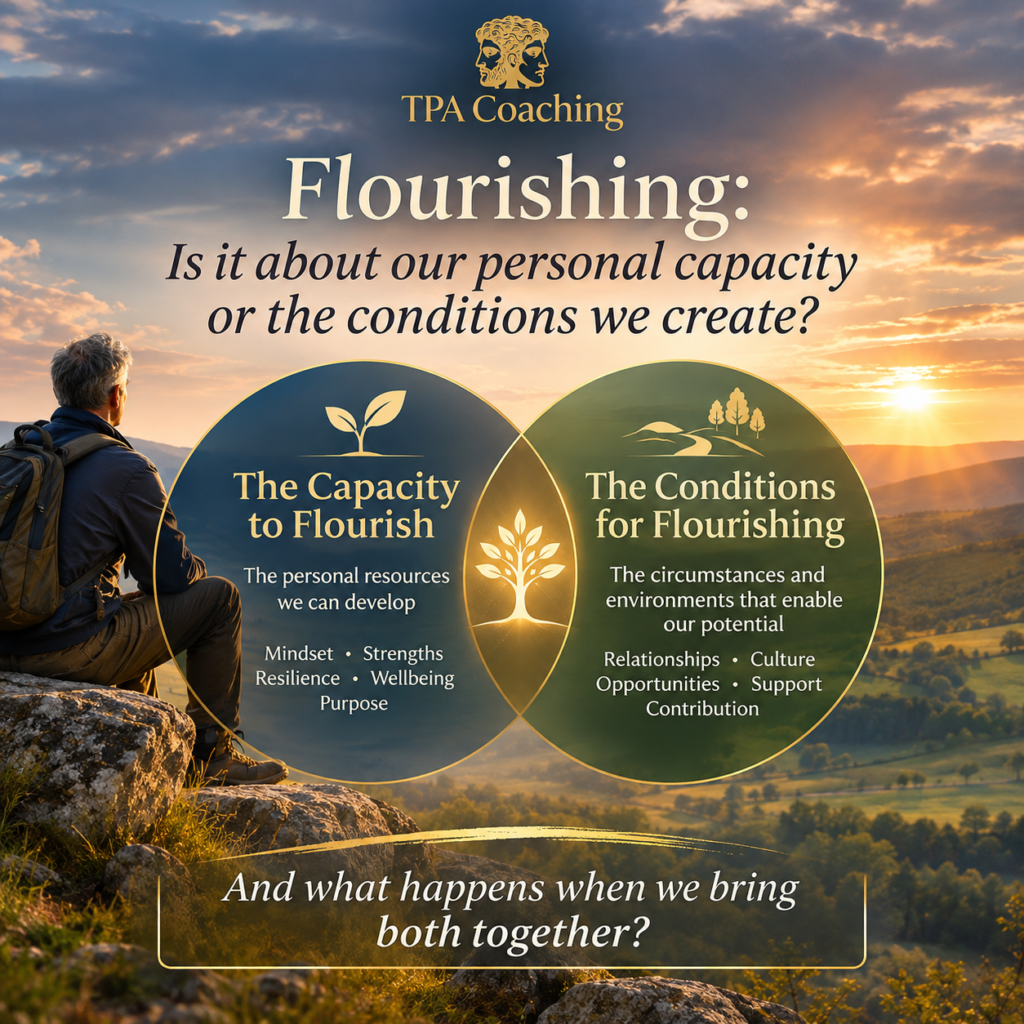
Is flourishing something we develop within ourselves, or is it something that becomes possible because of the circumstances in which we live?
My instinct is that it is neither one nor the other.
It is both.
Much of our contemporary conversation about wellbeing focuses on the individual. We are encouraged to develop resilience, recognise our strengths, cultivate positive emotions, find meaning and purpose, and take greater responsibility for our psychological and physical health.
These are all worthwhile pursuits, and they form an important part of what I have been developing through my Human Flourishing Architecture™.
But I wonder whether we sometimes overlook something equally important. We can develop considerable personal capacity to flourish, yet find ourselves in relationships, workplaces, communities or circumstances that offer limited opportunities to express that capacity.
Equally, we can find ourselves in supportive environments that offer opportunities for connection, growth and contribution, yet struggle to engage with them because our own psychological or physical resources are depleted.
This leads me towards a distinction that I think deserves greater attention.
There is a difference between developing our capacity to flourish and creating or finding the conditions in which flourishing becomes possible.
And perhaps understanding the relationship between the two is fundamental to living well.
What do I mean by the capacity to flourish?
When I talk about our capacity to flourish, I am referring to the personal resources and capabilities that help us engage with life in meaningful, constructive and adaptive ways. These are not simply personality traits or fixed characteristics. They are capacities that can be understood, developed, strengthened and expressed differently as our circumstances change.
Martin Seligman’s PERMA model offers one useful foundation. Positive emotions, engagement, relationships, meaning and accomplishment provide different perspectives on what contributes to wellbeing.
The VIA classification of character strengths adds another dimension, helping us recognise the qualities we bring to our experiences and how we might use them intentionally.
Physical Intelligence reminds us that flourishing is not simply a cognitive or emotional experience. Our physiological state, bodily awareness and capacity to regulate our responses influence how we engage with the world.
Resilience contributes our ability to adapt, recover and continue growing when life becomes challenging.
And, more recently, I have been exploring Social Flourishing through the work of Corey Keyes, considering how belonging, acceptance, contribution and our understanding of society influence our wellbeing.
Together, these perspectives provide much of the foundation for my Human Flourishing Architecture™. But I am increasingly reluctant to think of them as separate ingredients that we simply accumulate.
They interact.
Our emotional state affects our relationships. Our relationships influence our sense of meaning. Our physical wellbeing affects our capacity to engage. Our strengths influence how we respond to challenge.
Developing our capacity to flourish is therefore not simply about becoming more positive, resilient or accomplished.
It is about developing the resources, awareness and flexibility to engage with the opportunities and difficulties that life presents.
It is about increasing our capacity to live well, rather than expecting life always to go well.
But capacity alone is not enough
Imagine someone who has spent years developing their personal and professional capabilities. They are self-aware, emotionally intelligent, resilient and motivated. They understand their strengths and have a strong desire to make a meaningful contribution. Yet they work in an organisation where their ideas are dismissed, their autonomy is restricted and their contribution is rarely acknowledged.
They may possess considerable capacity to flourish. But the conditions around them make flourishing difficult.
Now consider someone navigating midlife.
They may be discovering new interests, reconsidering their values and beginning to develop a different understanding of purpose. Perhaps they are moving away from an identity built around career achievement and towards a desire for contribution, connection or generativity.
Yet the social environment around them may continue to value them primarily for what they have achieved, the position they hold or the economic contribution they make. Their inner world may be changing, but the opportunities available to express that change may be limited.
These examples highlight something important.
We cannot always develop our way out of an environment that continually undermines our wellbeing.
Resilience is valuable, but it should not become an expectation that people simply tolerate damaging circumstances.
Optimism can help us recognise possibilities, but it cannot remove every structural barrier.
Character strengths may provide important personal resources, but their expression depends, at least partly, on the opportunities and relationships available to us.
This is why I think we need to look beyond individual psychology.
What are the conditions for flourishing?
The conditions for flourishing are the circumstances, relationships, opportunities and wider systems that influence our ability to live well.
Some are immediate and personal.
The quality of our relationships. The degree of trust and psychological safety we experience. Whether we feel valued, respected and able to contribute.
Others are broader.
The culture of our workplace. The communities to which we belong. Access to opportunities, education, meaningful work and social participation.
And beyond these sit the larger economic, cultural and institutional systems that shape our lives.
These conditions do not determine our wellbeing completely.
People can demonstrate remarkable growth and meaning in difficult circumstances. Equally, favourable circumstances do not guarantee flourishing.
But the conditions matter.
In their 2020 paper Third Wave Positive Psychology: Broadening Towards Complexity, Tim Lomas and colleagues argue that positive psychology needs to move beyond its traditional emphasis on the individual and consider the wider systems within which human wellbeing develops. Their work draws attention to the interconnected nature of people, relationships, organisations, cultures and social structures.
One of the important implications is that responsibility for wellbeing cannot rest entirely with the individual. Organisations, institutions and communities also have a part to play in creating environments in which people can thrive. For me, this is an important development in how we understand flourishing.
It encourages us to move away from thinking solely about what people need to change within themselves and towards considering what might need to change around them.
Flourishing emerges through the relationship between the two
What interests me most is not simply that capacity and conditions are both important. It is that they continually influence one another.
Consider the character strength of curiosity.
Someone may have a natural interest in exploring ideas, asking questions and learning new things. In an environment that encourages experimentation, curiosity can become a source of engagement, growth and accomplishment. But in an environment where questioning is discouraged or mistakes are punished, that same strength may remain underused or even become a source of frustration.
The personal capacity has not necessarily disappeared. The conditions for its expression have changed.
The relationship also works in the other direction.
As someone develops greater confidence, emotional awareness or resilience, they may begin to engage differently with their environment. They might initiate conversations they previously avoided, seek new relationships, challenge established expectations or recognise opportunities that had previously seemed unavailable. In doing so, they may begin to change some of the conditions around them.
This is what I find compelling about a more systemic understanding of flourishing. We are influenced by our circumstances, but we also participate in shaping them.
Our capacity affects how we engage with our environment, and our environment affects how our capacity develops and finds expression.
Flourishing emerges through this continuing interaction. It is not a static state that we achieve and then possess. It is an evolving relationship between who we are, who we are becoming and the world in which we live.
Social flourishing, the bridge between capacity and conditions?
This brings me back to my recent exploration of Corey Keyes’ work on social wellbeing. Keyes identified five dimensions of social wellbeing: social integration, acceptance, contribution, actualisation and coherence.
What I find particularly valuable about this framework is that it directs our attention towards our relationship with the social world.
Do we feel that we belong?
Do we believe we have something worthwhile to contribute?
Can we make sense of the society in which we live?
Do we see the possibility of growth and development in the communities around us?
These are personal experiences, but they are inseparable from our social circumstances. We might have a strong desire to contribute, but struggle to find opportunities where that contribution is welcomed. We might value belonging, but find ourselves in communities where we feel excluded. We might possess considerable social confidence, yet experience environments where trust and connection are difficult to establish.
This is why I have been considering Social Flourishing as a distinct element within my Human Flourishing Architecture™. It adds something beyond the quality of our immediate personal relationships. It encourages us to consider our sense of participation in the wider world. And perhaps it also provides a useful bridge between our personal capacities and the conditions in which they find expression.
I do not yet see this as a settled conclusion, but rather an interesting direction for further exploration.
What does this mean for the Human Flourishing Architecture™?
As I continue developing the architecture, I am beginning to see two interconnected perspectives.
The first concerns the capacity to flourish.
This includes the psychological, emotional, physical and social resources that enable us to engage with life, navigate difficulties, recognise possibilities and pursue meaningful development.
The second concerns the conditions for flourishing.
These include the relationships, environments, opportunities and wider systems that enable or constrain the expression of those capacities.
I do not necessarily see these as two separate sets of components. Rather, they offer two different ways of looking at the same human experience. The architecture helps us understand the capacities we can develop. A systemic perspective encourages us to understand the circumstances in which those capacities must operate.
This distinction also challenges the idea that flourishing is simply a matter of individual responsibility.
We have agency, but not unlimited control. We can influence some of our circumstances, but not all of them. We can develop our resources, but there will be occasions when personal development alone is insufficient. And sometimes, flourishing may require us to change our relationship with the world rather than simply change ourselves.
The particular relevance to midlife transition
I find this distinction especially meaningful when considering midlife. Much of my work with transition explores the experience of standing at a threshold. A period when familiar identities, assumptions and sources of meaning begin to shift, often before we have developed a clear understanding of what might replace them.
We may become more aware of our values, more interested in authenticity and less willing to invest our time in activities that no longer feel meaningful. We may begin to question what we are growing towards rather than simply what we have achieved.
These are changes in our personal capacity for reflection, awareness and development. But they can also create tension with the conditions of our existing lives.
The career that once provided recognition may no longer offer meaning.
The relationships that supported an earlier identity may need to evolve.
The expectations of others may no longer align with our emerging sense of self.
And the opportunities we need for the next stage of life may be different from those that supported the previous one.
Perhaps this is one reason why transition can feel so uncomfortable.
We may be developing the capacity to flourish in new ways while continuing to live within conditions shaped by an earlier version of ourselves.
The challenge is not simply to understand who we are becoming. It is also to explore where and how that emerging self might find opportunities for expression. This may involve changing our circumstances. But it may equally involve changing how we participate in them.
Developing new relationships, discovering different forms of contribution, renegotiating expectations or recognising possibilities that we had previously overlooked. And sometimes it may involve accepting that certain circumstances are beyond our influence and making thoughtful choices about how we respond.
This is where the work of transition and the development of flourishing become closely connected.
A different conversation about wellbeing
If we accept that flourishing depends upon both personal capacity and enabling conditions, perhaps we also need to change some of the questions we ask.
Instead of asking only:
How can I become more resilient?
We might also ask:
What is it about my circumstances that continually requires me to be resilient?
Instead of asking:
How can I find more meaning in my life?
We might explore:
Where do I have opportunities to make a contribution that genuinely matters to me?
Instead of asking:
Which strengths should I develop?
We might consider:
Where and how can my existing strengths find meaningful expression?
And instead of focusing exclusively on what needs to change within us, we might ask:
What needs to change in the relationship between myself and the world around me?
These are not either-or questions. They are complementary perspectives. They encourage personal responsibility while recognising the importance of context, and they also offer a more compassionate and realistic understanding of human development.
Not every difficulty can be overcome through greater effort, positivity or resilience. Sometimes the most constructive response is to recognise that the conditions themselves need attention.
So, what are we really trying to develop?
I began developing the Human Flourishing Architecture™ with an interest in understanding what enables people to live well.
That interest remains.
But my thinking is evolving. I am becoming less interested in flourishing as an ideal state that we might eventually achieve and more interested in our ability to engage with life in ways that support continuing growth, meaning and contribution. This has led me towards a proposition that increasingly captures the purpose of my coaching work:
Helping people develop their capacity to flourish, while recognising and engaging with the relationships, environments and systems that shape their opportunities to do so.
I think this distinction matters.Because flourishing is neither solely an individual achievement nor simply the product of favourable circumstances.
It emerges through the dynamic relationship between our personal capacities, lived experiences, social connections and the wider systems within which our lives unfold.
Sometimes our work is to develop ourselves.
Sometimes it is to change our circumstances.
And sometimes it is to discover a different way of relating to the world we already inhabit.
Perhaps the most important thing is recognising that all three possibilities deserve our attention.
Flourishing is not simply about becoming more capable. It is also about discovering, creating and participating in the conditions that allow those capabilities to become meaningful.
And perhaps that is what it really means to develop our capacity to flourish.
References
Keyes, C. L. M. (1998). Social well-being. Social Psychology Quarterly, 61(2), 121–140. https://doi.org/10.2307/2787065
Lomas, T., Waters, L., Williams, P., Oades, L. G., & Kern, M. L. (2020). Third wave positive psychology: Broadening towards complexity. The Journal of Positive Psychology. https://doi.org/10.1080/17439760.2020.1805501
Seligman, M. E. P. (2011). Flourish: A visionary new understanding of happiness and well-being. Free Press.
Summary of TPA Coaching.
At TPA Coaching, I work with people exploring midlife transition, well-being, changing identities and the search for meaning and purpose. If something is stirring and you would value a thinking partner, perhaps an initial conversation is a useful place to begin.
Get in touch at tim@tpacoaching.com