

Too Young to Be Wanted. Too Old to Be Valued. What Have We Got Wrong?
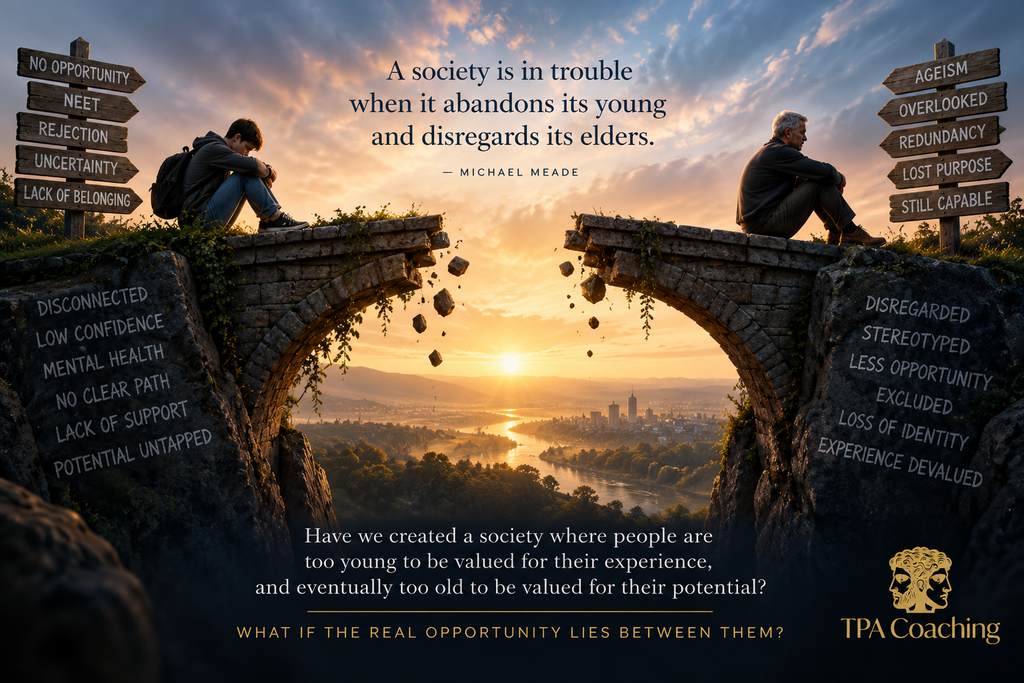
“Have we created a society in which people are too young to be valued for their experience, and then eventually too old to be valued for their potential?”
I wanted to continue my work around transitions and successful ageing and flourishing however my thoughts keep coming back to Michael Meade’s work and his statement:
“A society is in trouble when, at one end of the age spectrum, it abandons its young and, at the other, disregards its elders.“
Just this week alone I have seen newsreels within the UK media that share on the one hand where Prime Minister Andy Burnham has warned the UK faces an “economic catastrophe and moral failure” due to the nearly one million young people not in education, employment or training. https://www.bbc.co.uk/news/articles/cq0melgpre23o and Brits Over 50 Face ‘Alarming’ Jobs Crisis as More Struggle to Find Work Before Retirement https://www.ibtimes.co.uk/employment-crisis-older-workers-call-action-1818333
Look around and it is difficult not to wonder whether we are witnessing something of this now. In April–June 2026, 981,000 16–24-year-olds were NEET—13% of that age group. Office for National Statistics At the other end, the Centre for Ageing Better reports that employment rates decline markedly after 55 and that 17% of people over 50 report missing workplace opportunities because of age. It also reports that 1.1 million working-age people aged 60+ are living in poverty.
In the UK, significant numbers of young people are not in education, employment or training. NEET has become an acronym sufficiently familiar that perhaps we risk forgetting that behind it are individual young people trying to work out where they belong and whether there is a meaningful place for them in the world around them.
At the other end of working life, we see a different form of exclusion.
People in their fifties and sixties describe being overlooked for roles, development and promotion. Experience that took decades to accumulate can suddenly appear less valuable. The language changes too. Someone who was once described as “experienced” can find themselves regarded as “older”.
Two ends of the age spectrum. Two very different experiences. But perhaps they are not entirely separate problems.
What if we are asking the wrong questions?
We spend considerable time debating how to get young people into employment, education and training.
At the other end, we debate how to keep older people economically active, encourage longer working lives and address age discrimination.
Both are important.
But I wonder whether we have become so focused on the economic consequences of these challenges that we are overlooking something fundamentally human.
What happens to someone’s sense of worth when society appears to have no meaningful place for them?
For a young person, repeated rejection or the absence of opportunity may influence confidence, identity, belonging and expectations for the future.
For someone approaching later working life, being overlooked or marginalised may challenge an identity built over decades.
Neither experience is universal. Nor are the circumstances equivalent. Young people classified as NEET face widely differing challenges, including ill health, caring responsibilities, disability and barriers to opportunity. Older workers experience equally varied circumstances.
But there may be something shared in the experience of exclusion.
A question that perhaps neither generation expected to be asking:
Do I still matter?
And if our sense of mattering, belonging and contribution is so important to well-being, shouldn’t we be asking more about the human consequences of these experiences?
An uncomfortable question for those of us growing older
Throughout my recent writing on midlife transition, I have explored the idea that growing older does not necessarily mean that we stop growing.
I have questioned our preoccupation with longevity, the assumption that retirement represents the inevitable destination of later life, and the possibility that our later years might offer opportunities for further development, flourishing and contribution.
I have also explored the concept of eldership through the work of Trevor Waldock and Michael Meade.
But something troubles me.
Why should a younger generation necessarily want to listen to us?
We have accumulated experience, certainly. We may have developed wisdom. But we have also participated in, benefited from and sometimes helped sustain systems that younger generations are now inheriting.
Systems associated with environmental damage, inequality, economic insecurity and divisions within society. Does having lived through those systems necessarily qualify us to advise those who must live with their consequences? And equally, why should we assume that younger people lack wisdom simply because they lack years?
Perhaps there is something uncomfortable here for both generations. Older people may need to question whether their experience remains relevant. Younger people may need opportunities to discover whether some of that experience could be valuable.
But neither should be expected to accept the other’s contribution simply because of age.
What if the relationship itself is the opportunity?
Erik Erikson described a central developmental tension of middle adulthood as generativity versus stagnation.
Generativity concerns our capacity to nurture, create and contribute to something beyond ourselves, including the well-being and development of future generations.
It is a concept I find increasingly relevant to my work on midlife transition.
But I wonder whether we sometimes interpret generativity too narrowly.
We imagine older people mentoring younger people, passing on knowledge and helping them navigate life’s challenges.
That may be valuable.
But what if generativity requires us to receive as well as give?
What if the person approaching 60 needs the perspective of the person approaching 20 just as much as the younger person might benefit from their experience?
What if younger people could challenge assumptions that have shaped our careers, our organisations and our understanding of success?
What if those of us in midlife could offer access, encouragement, networks and opportunities without expecting younger people to reproduce the lives we have lived?
Perhaps the opportunity isn’t simply knowledge transfer.
Perhaps it is mutual development.
Two generations, each possessing something the other does not, but neither having a monopoly on wisdom, opportunity or possibility.
And what about the systems in between?
There is another complication.
We cannot simply place responsibility for these challenges on individuals.
Ageism is not resolved by telling older people to become more resilient.
Youth exclusion is not resolved by telling young people to become more employable.
Both experiences are shaped by wider systems: employers, education, recruitment practices, government policy, social expectations and the way we define economic value.
And perhaps this is where the real provocation lies.
Why do we continue to organise working life around assumptions about age that may no longer serve either generation?
Why do we so often associate youth with potential but insufficient experience?
Why do we associate age with experience but diminishing potential?
And why, when we talk about flourishing, do we so frequently focus on what individuals must do to adapt rather than questioning the environments in which they are expected to flourish?
I wonder whether there is an opportunity here for organisations, communities and individuals to think differently.
Not simply to extend working lives.
Not simply to create more mentoring programmes.
But to reconsider how generations might work, learn and contribute alongside one another.
Perhaps this is another threshold
In my transition work, I frequently return to the idea of the threshold: that space in which we begin to reconsider who we are, what has shaped us and how we wish to live and contribute next.
Perhaps the threshold is not always an individual experience.
Perhaps organisations and societies also reach thresholds where their established assumptions no longer seem adequate.
We are living longer.
The nature of work is changing.
The expectations of younger generations are changing.
And the conventional relationship between age, employment, status and contribution increasingly deserves examination.
Could this be an opportunity to reconsider not only how we age, but how we live alongside those at different stages of life?
And might some of us navigating midlife transition have a role in that conversation?
Not because we have the answers.
But because we may have reached a stage where we are prepared to question the answers we previously accepted.
I don’t have the answer. But I would like to start a conversation.
I began with Michael Meade’s warning about a society that abandons its young and disregards its elders.
I am left wondering whether we are overlooking an opportunity that sits somewhere between them.
Perhaps those of us growing older have something to offer younger generations.
Perhaps younger generations have something equally valuable to offer us.
Perhaps organisations could become places where experience and emerging perspectives are brought together rather than separated by assumptions about age.
Or perhaps the problem is more deeply embedded in the way we organise society, opportunity and economic participation.
I don’t want to assume that another mentoring programme is the answer.
Nor do I want to suggest that older people should become responsible for solving the challenges facing younger people.
But I do want to ask whether there is something we could do differently.
So I would genuinely welcome your thoughts.
- What could someone in their fifties or sixties learn from a young person struggling to find their place in the world?
- What could that older person offer in return, beyond advice and stories about how things used to be?
- What would employers and communities need to change to make meaningful intergenerational exchange possible?
- And perhaps most importantly, what might we create if we stopped viewing youth and ageing as separate problems and started recognising the potential in their relationship?
Because perhaps the measure of a flourishing society is not simply how long its people live, how productive they remain or how quickly its young people enter employment.
Perhaps it is whether people, whatever their age, can continue to experience belonging, purpose, contribution and the sense that they matter.
And perhaps that is a conversation worth having before we attempt to build another bridge.
Summary of TPA Coaching.
At TPA Coaching, I work with people exploring midlife transition, well-being, changing identities and the search for meaning and purpose. If something is stirring and you would value a thinking partner, perhaps an initial conversation is a useful place to begin.
Get in touch at tim@tpacoaching.com