
Beyond the Threshold: What If the Next Stage Is Not About You?
In my last article I asked a deceptively simple question:
Who exactly is standing at the threshold?
It emerged from my continuing exploration of transition, particularly that strange period in life when something begins to stir. Nothing may be obviously wrong. We may still be successful. Still productive. Still busy. Still valued.
And yet the assumptions, identities, ambitions and systems that have carried us this far somehow no longer fit quite as comfortably as they once did.
Perhaps the interesting question is not simply what we are transitioning from. Perhaps it is what we are transitioning towards. And increasingly I find myself wondering whether, for some of us at least, the answer might have something to do with eldership, not old age per se, not retirement and not status and definitely not the assumption that simply accumulating years somehow makes us wise.
Something rather more demanding than that.
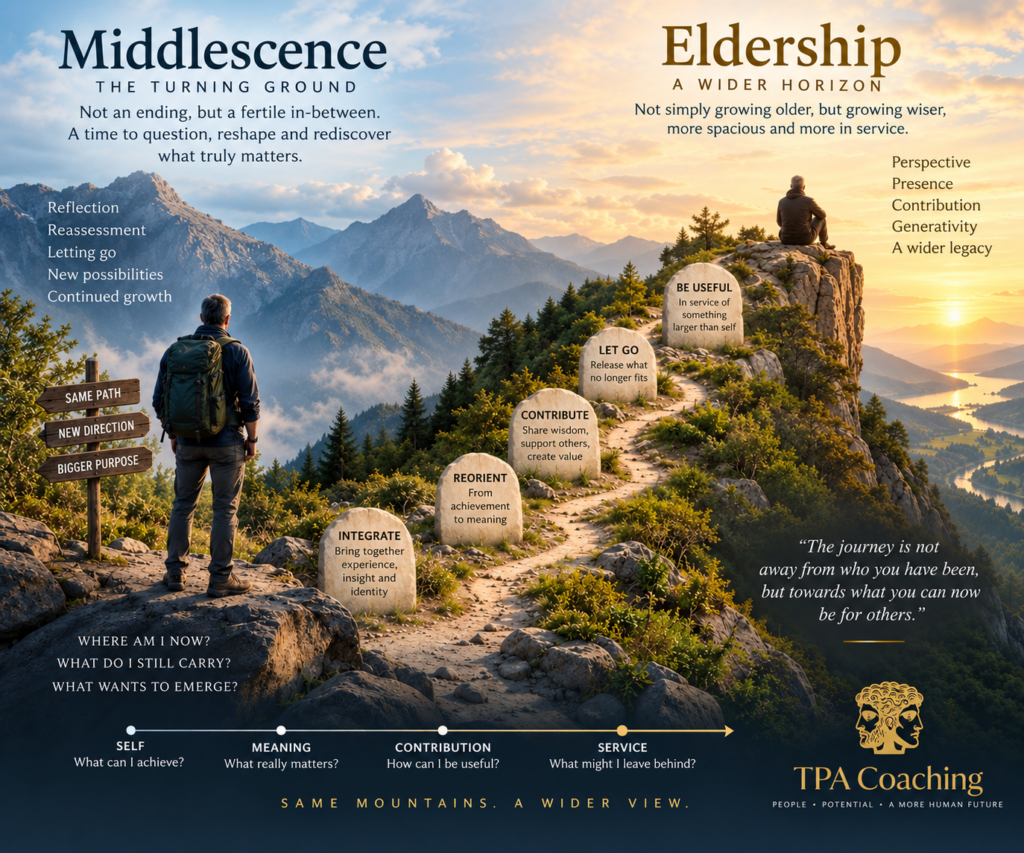
From Middlescence to Eldership
Barbara Waxman’s idea of Middlescence has been important in my thinking because it challenges one of our deeply embedded assumptions about ageing: that development largely belongs to the first half of life.
What if it doesn’t?
In a world of increasing longevity, the period traditionally labelled “midlife” may contain decades of potentially productive, creative and meaningful living.That changes the question.
Instead of:
How do I hold on to what I have?
we might begin asking:
What could these additional years be for?
There is an important distinction.Longevity gives us more time.It does not necessarily tell us what to do with it.
And perhaps this is where Trevor Waldock’s writing about thresholds and eldership becomes particularly interesting because eldership suggests that development might eventually involve a subtle change in direction.
For much of adult life we are encouraged to build. A career, a reputation, our expertise, financial security, a family, a network, an identity. There is nothing inherently wrong with any of these things. They may be essential parts of becoming ourselves, but there may come a point when another question begins quietly knocking at the door:
What is all this experience now for?
From Accumulation to Contribution
I am beginning to think that this may be one of the most interesting movements available to us in later adult development. A movement from accumulation towards contribution. From proving towards providing. From achievement towards meaning. Perhaps even from success towards service.
That does not require abandoning ambition, expertise or identity.
Quite the opposite.
Ken Wilber uses the wonderfully useful idea of “transcend and include.” Development does not necessarily require us to throw away the person we have been. We carry that person with us. All the experiences, all the mistakes, all our successes, all our scars, all our knowledge, our relationships, our contradictions. Perhaps maturity involves learning how to hold all of these differently.
The executive does not have to stop being an executive.
The entrepreneur does not have to stop creating.
The expert does not have to abandon expertise.
But their relationship with those identities might change.
Instead of asking:
What can this identity give me?
we might begin asking:
What can I now give through it?
That feels like a very different orientation to life. And it mirrors my thoughts in my last blog where I referenced John Whittington’s thoughts on constellations.
Growing Older Is Not the Same as Growing Up
And here I encounter an uncomfortable thought. We frequently use age and maturity almost interchangeably, but they are clearly not the same thing.
Robert Kegan’s work on adult development is particularly helpful here. His developmental theory suggests that adults can continue developing increasingly complex ways of making meaning. At the later end of his model sits what he calls the self-transforming mind. Here we become increasingly capable of standing outside the systems of belief that previously defined us. Our worldview becomes something we can examine rather than simply something through which we examine everything else.
That connects powerfully for me with my previous exploration of systems.
Perhaps at the threshold I begin to notice:
the organisation I belong to is a system.
my profession is a system.
my family is a system.
my generation is a system.
my beliefs about success are part of a system.
And perhaps, most challengingly:
I am not separate from any of them.
I have shaped them and they have shaped me.
But I do not necessarily have to remain imprisoned by them.
This is where the threshold becomes developmental rather than merely transitional.
Beyond Self-Actualisation?
There is another fascinating connection here. Most of us know Abraham Maslow through the familiar pyramid culminating in self-actualisation. Become what you are capable of becoming.
It is an idea I find enormously attractive and one that sits comfortably alongside Carl Rogers’ concept of the actualising tendency. But Maslow’s thinking continued. Towards the end of his life he increasingly considered something beyond self-actualisation:
self-transcendence.
The possibility that our fullest development might eventually involve moving beyond an overriding preoccupation with ourselves. Towards something larger. Other people. Future generations. Community. Nature. Justice. Meaning. Service.
Perhaps the question changes from:
Who can I become?
to:
What can I contribute because of who I have become?
That feels remarkably close to eldership.
The Elder Is Not Simply the Oldest Person in the Room
This distinction matters enormously because I do not think eldership can simply be bestowed by age. There are plenty of older people who remain deeply attached to status, certainty, power and being right. Equally, there are younger people capable of remarkable wisdom, perspective and service.
So perhaps we need to separate elder from older.
An elder, as I am beginning to understand the idea, is someone whose accumulated experience has increasingly become available in service of something beyond themselves.
They do not need to occupy centre stage. They might instead help others onto it. They do not dispense answers simply because they have lived longer.
Perhaps they have become better at holding questions.They recognise that their experience matters while simultaneously recognising that the world in which that experience was acquired has changed.
That last point seems particularly important because an elder who insists that the future must resemble their past is not necessarily offering wisdom. They may simply be preserving their identity.
Standing at Another Threshold
And so perhaps there is another threshold hidden inside the one I have been exploring.
Waxman reminds us that we may have far more developmental life ahead of us than previous generations imagined. Waldock invites us to consider the possibility of eldership. Kegan asks us to examine whether we can develop beyond the systems of meaning that have constructed our identity. Maslow points beyond actualisation towards transcendence. Wilber reminds us that development need not mean rejecting what has gone before, but transcending and including it.
Together they leave me with a rather wonderful possibility.
Maybe later life is not primarily about becoming less.
Less relevant.
Less ambitious.
Less visible.
Less useful.
Perhaps it offers the possibility of becoming more spacious.
More able to hold complexity.
More willing to question our certainty.
More capable of seeing beyond ourselves.
More prepared to use what we have accumulated in service of others.
And perhaps this is where flourishing takes on a different meaning.
Not simply:
How might I flourish?
But:
How might who I am becoming enable others to flourish too?
That brings me towards a subject I want to explore next. Because there is a danger lurking inside this rather attractive idea. If eldership represents a developmental possibility, does everyone inevitably become an elder simply by growing older?
Kegan’s work would suggest not. Maslow’s work raises similar questions. And if transcendence represents some form of developmental movement beyond ourselves, we have to confront an uncomfortable possibility:
perhaps growing older is inevitable, but growing beyond ourselves is not.
That is the tension I want to explore next as well as our assumed right to take the position as elder.
.