

Who Exactly Is Standing at the Threshold?
Midlife, Systems, Belonging and Finding Our Place
In my last blog, When Something Begins to Stir: Midlife, Thresholds and the Invitation to Become, I explored the idea that the restlessness we sometimes experience in midlife may not necessarily be evidence of a crisis. Perhaps it is an invitation.
Drawing on Barbara Waxman’s concept of Middlescence, I considered midlife as a continuing period of adult development rather than simply a period of ageing or decline.
Trevor Waldock’s work on thresholds added another perspective A threshold is that curious space between what has been and what has yet to become. We may recognise that something no longer fits before we have any idea what should replace it.
The career may still be successful, but somehow matter less.The things that once motivated us may have lost some of their attraction.Our relationship with achievement, status, possessions or ambition may begin to change.
Perhaps the questions themselves change.
From: What else can I achieve? towards: What actually matters now?
From: What can I accumulate? towards: What might I contribute?
And perhaps from: What do I want to do next? towards the much more interesting: Who am I becoming?
But who exactly is standing at the threshold?
Because there is a danger in imagining this as an entirely individual journey. A solitary person standing at a doorway, deciding whether to remain where they are or step courageously into their new life. Real life is considerably messier than that. We don’t arrive at midlife alone. We arrive carrying our systems with us. And that changes the conversation.
We Are All Part of Something
This is where John Whittington’s work in Systemic Coaching and Constellations has added another layer to my thinking. Systemic coaching asks us to widen the lens. Rather than looking solely at the individual and asking:
“What do you want?”
we become interested in something bigger:
“What systems are you part of, and what is happening between you and those systems?”
Because none of us develops in isolation. We belong, we have families, we have relationships, we have friendship groups, we work in organisations, we may have a profession, we live within communities, we are raised within a culture, we belong to a generation.
We may simultaneously be a parent, child, partner, leader, colleague, friend, mentor, employee, business owner and member of a community.
Each comes with relationships, each has expectations, each has history, and each may have helped shape our understanding of who we are.
That makes midlife transition much more interesting.
Perhaps the stirring isn’t simply happening within us.
Perhaps something is also changing between us and the systems to which we belong.
When Our Place Begins to Change
Imagine someone who has spent thirty years building a successful professional identity. They haven’t simply accumulated skills and experience. They have found a place. People know who they are, their job title means something, their experience gives them authority. They have relationships, networks, responsibilities and perhaps status. They understand how the system works. They know where they belong within it. Then something begins to stir… “I don’t think I want to do this anymore.”
On the surface, that might look like a career question. What should I do instead? But systemically, the question may be much deeper.
If I leave this organisation: Where do I belong?
If I am no longer the Managing Director: Who am I?
If my children no longer need me in the way they once did: What is my place as a parent now?
If I stop pursuing the success that has driven me for thirty years: What takes its place?
And perhaps the most uncomfortable question: What will other people think if I change?
Suddenly transition isn’t simply about choosing something new, it is also about renegotiating our relationship with everything that helped create the person we have become.
The Systems That Travel With Us
And some of those systems began influencing us long before we entered the workplace. Our earliest system was usually our family. Long before we consciously developed beliefs about work, success, money, leadership, relationships or responsibility, we were observing them.
What did success look like in my family? What did work mean? What did money mean? Who had authority? Who looked after whom? Was security valued above adventure? Was achievement celebrated? Was failure tolerated? Was emotion expressed or contained? What did it mean to be a “good” son or daughter?
Later perhaps: What does a good husband, wife, father, mother, leader or provider do?
We absorb stories about how the world works, and because they become familiar, we may stop noticing that they are stories at all they simply become:“This is what people like us do.”
That is where systemic thinking becomes particularly useful because transition can expose some of these assumptions. When I begin contemplating a different way of living, leading or contributing, I may discover that I am not simply wrestling with a decision. I may also be wrestling with belonging and loyalty.
The Invisible Pull of Belonging
Belonging is powerful, most of us want to belong. We belong with our families, perhaps we identify with our profession, our organisations, our communities, churches, sports teams, hobby groups. We might associate and identify as being part of a movement, or belonging to a certain generation but belonging can come with invisible expectations.
Imagine someone whose parents worked extraordinarily hard to give them opportunities they never had themselves. They become successful, educated, professionally respected, financially secure. Then, at 55, they begin wondering whether they want to leave that successful career and do something very different.
Logically, they may be perfectly capable of doing so.Financially, it may even be possible. Yet something stops them.Perhaps beneath the practical questions lies another:“After everything that was sacrificed for me to get here, am I really allowed to walk away?”
That isn’t necessarily a rational question. It is a question about belonging.
Or perhaps someone has spent decades being the provider. Their identity, family relationships and sense of self have developed around being dependable. Then they begin wanting a different relationship with work. Again, the question may not simply be: “Can I afford to work less?” It may be: “Who am I if I am no longer the person everyone depends upon?”
This is why I increasingly think we need to be careful with the language of reinvention. Midlife isn’t necessarily about throwing everything away and inventing a new self. Our histories matter, our relationships matter, our responsibilities matter.
The invitation may instead be to recognise what has shaped us and then consciously decide how we want to relate to it now. And this is where Whittington’s concept of time, place and exchange become interesting to my thoughts.
Time, Place and Exchange
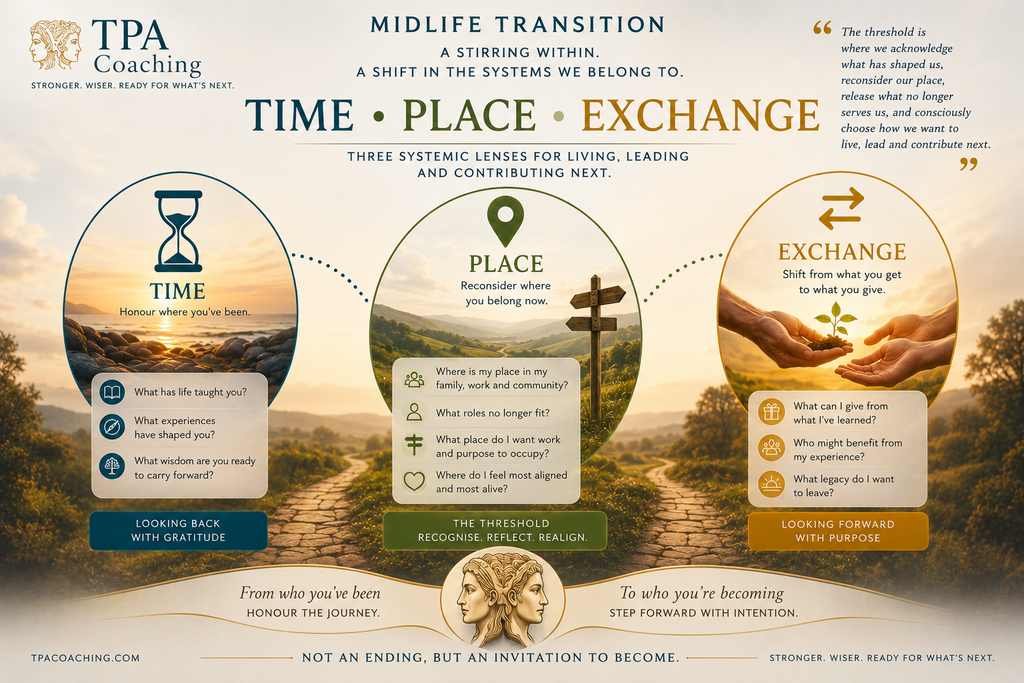
One aspect of systemic thinking that I find particularly useful is the consideration of time, place and exchange. All three become fascinating when viewed through the lens of midlife.
TIME: Honouring Where We’ve Been
There is an order to our lives, we cannot return to being twenty-five and neither should flourishing require us to pretend that we can. Midlife invites us to acknowledge our place in time and that includes recognising loss.
Bodies change, opportunities change, relationships change, people we love age and die, some doors genuinely close.
But time doesn’t only take things from us. Time gives us things too.
We collect experience perspective, pattern recognition, self-knowledge, stories, relationships, maybe greater compassion and love, and, if we reflect on our experience rather than merely accumulate it, potentially wisdom.
So perhaps the question isn’t: “How do I remain young?” It becomes:“What becomes possible precisely because I am no longer young?”
There is something quite liberating about that.
PLACE: Where Do I Belong Now?
Then there is place, our place within systems changes throughout life. The child eventually becomes the adult supporting an ageing parent. The young manager becomes the experienced leader. The apprentice becomes the mentor. The parent of young children becomes the parent of independent adults. The person who once needed guidance becomes the person others approach for wisdom.
So perhaps midlife creates a legitimate need to ask: Where is my place now?
What is my place within my family? What is my place within my organisation? What is my place within my profession? What place do I want work to occupy within my life? Where do relationships sit? Where does service sit? Where does my own life sit amongst all these responsibilities?
Perhaps part of the stirring occurs because the place we have occupied for many years no longer quite fits, and perhaps the task isn’t immediately to leave the system. It may be to reposition ourselves within it.
EXCHANGE: From What I Get to What I Give
Then there is exchange. This may be the one I find most intriguing when considering the transition into later midlife. Much of earlier adult life understandably involves acquisition.
We build our career, we build our knowledge, we gain qualifications, we gather experience. With luck we might gather financial security. We build associations and networks, we gain a reputation, we amass possessions
We need things from the systems around us, and we exchange our energy, effort and abilities for them. But might the nature of that exchange begin to shift? Perhaps at some point the question becomes less: “What can I get from this?” and increasingly:“What can I give?”
What do I know now that might help somebody else? What experience can I share? Who might benefit from the mistakes I’ve made? Who might I mentor? What might I contribute to my organisation, profession, family or community that isn’t simply about my own advancement?
This takes me back towards Waldock and his thinking about eldership. Perhaps the movement through midlife isn’t simply from one career stage to another.
Perhaps it can represent a deeper transition: From accumulation towards contribution. From achievement towards meaning. From authority towards stewardship. From leadership towards eldership. From success towards significance.
Transition Is Relational
This changes my original thesis about midlife transition. I began by thinking primarily about the individual who senses that something is stirring, but perhaps we need to go further.
Midlife transition occurs when an inner stirring meets a changing relationship with the systems to which we belong.
The threshold then becomes the space in which we can acknowledge what has shaped us, reconsider our place, release what no longer serves us and consciously choose how we want to live, lead and contribute next. That doesn’t mean abandoning our systems. It doesn’t mean rejecting our families, careers or histories. And it certainly doesn’t mean declaring everything that came before midlife is somehow misguided. Quite the opposite.
Perhaps healthy transition begins with saying: This brought me here. This family, this career path, these relationships, these successes, these failures, these people, these choices. Each of these is part of me and who I have become.
Acknowledgement doesn’t require permanent attachment, we can honour what brought us here while becoming curious about what might take us forward.
Conclusion
Midlife transition occurs when an inner stirring meets a changing relationship with the systems to which we belong. The threshold is the space in which we acknowledge what has shaped us, reconsider our place, release what no longer serves us, and consciously choose how we want to live, lead and contribute next.
.