

The Art of Flourishing: Creativity, Ageing and the Things That Make Us Feel Alive
I have been thinking a great deal recently about ageing, flourishing and what it really means to continue growing as we move through the second half of life.
Perhaps unsurprisingly, I keep finding myself drawn back to the work of gerontologist Barbara Waxman and her concept of Middlescence.
Waxman challenges the idea that the years between midlife and older age should somehow represent the beginning of decline. Instead, she invites us to consider them as another significant developmental period: a time when identity, purpose, relationships and our understanding of what matters can all be reconsidered.
That resonates deeply with my own exploration of Human Flourishing. Increasingly, I am coming to believe that flourishing is not something we eventually achieve. It is something we continue to practise. And one practice I may previously have underestimated is creativity.
Creativity is not the same as being creative
When we hear the word creativity, many of us immediately exclude ourselves.
“I can’t paint.”
“I can’t play an instrument.”
“I’ve never been artistic.”
But perhaps we have misunderstood what creativity really means.
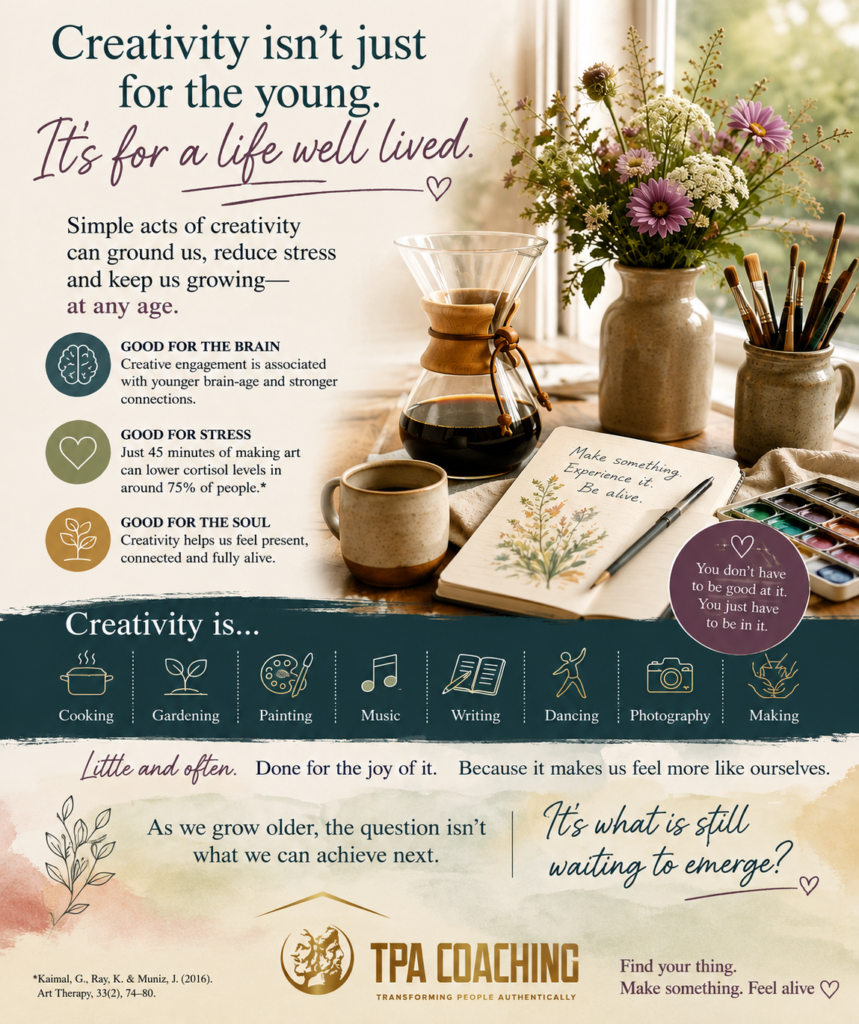
Creativity can be cooking, gardening, writing, photography, woodwork, making music, moving our bodies, trying a new recipe, planting something and watching it grow.
It may matter far less whether we are objectively good at something than whether we become absorbed in doing it. That distinction feels important.
I recently read a lovely reflective piece from Barbara Waxman when she shared rediscovering a sense of groundedness after returning home. Her creativity appeared not through an easel or a canvas but through making coffee slowly, cooking, working in the garden and celebrating family life.
There was something wonderfully ordinary about it. And perhaps flourishing often is ordinary. Not dramatic transformation. Not endlessly pursuing some better version of ourselves. Sometimes it may simply be becoming sufficiently present to experience the life already happening around us.
When making becomes regulating
There is some fascinating research behind this. A study associated with Drexel University explored what happened when adults spent 45 minutes making art. Around three quarters of participants experienced a reduction in cortisol, one of the hormones associated with the body’s stress response.
Perhaps most interestingly, previous artistic experience did not appear to be particularly important.
You didn’t need to be an artist.
You simply needed to participate.
There is something here that connects strongly with my recent reading around the nervous system and the work of Stephen Porges and Deb Dana. When we feel threatened, overwhelmed or continually pressured, our attention naturally narrows. We become vigilant. We protect. We react.
Creativity requires something rather different. It asks us to explore, to experiment,to become curious,to notice.
In other words, creativity may often emerge most easily when the nervous system experiences enough safety to move beyond defence and towards engagement.
And perhaps the relationship works in both directions.
Feeling safe can make creativity possible, while creative activity itself may help us settle, regulate and reconnect.
Attention changes experience
This also takes me back to Mihaly Csikszentmihalyi and his work on flow.Most people know that wonderful feeling of becoming so absorbed in something that they temporarily lose track of time.
Csikszentmihalyi helped us understand that where we place our attention profoundly influences the quality of our experience.
A musician playing. A gardener tending a border. Someone baking bread. A grandparent making something with a grandchild. An amateur painter completely absorbed in colour and shape.
For that period of time, the constant mental commentary can quieten. We are no longer thinking about yesterday or rehearsing tomorrow. We are simply involved.
And engagement, of course, is one of the central components of Seligman’s PERMA model of flourishing.
Perhaps creativity provides one of the most accessible pathways into it.
Growing older or continuing to grow?
This is where Waxman’s work becomes particularly interesting for me. The traditional model of life has often been surprisingly linear.
We learn. We work. We achieve. We retire. We decline.
But longer lives are disrupting that story.
If someone reaches their fifties or sixties in reasonable health today, there may potentially be decades of life ahead.
So a much more interesting question emerges:
Who might I still become?
That question shifts us from ageing to development. And this connects with another theme I have been exploring recently: horizontal and vertical development.
Horizontal development asks us to add skills, knowledge and capability. Vertical development asks something deeper.
Can we expand the way we make sense of ourselves and the world? Creativity can potentially offer both.
Learning photography may give me a new skill. But learning to truly look may change what I notice.
Painting might teach technique. But it might also teach patience.
Gardening might teach me about plants. But perhaps it also teaches me about seasons, uncertainty and letting go.
Cooking may produce dinner. But it may also become an expression of care, connection and identity.
The activity is horizontal. What it awakens within us may be vertical.
From achievement to generativity
There is another word worth introducing here: generativity.
Erik Erikson used the term to describe an important developmental task of adulthood: our desire to create, nurture and contribute something that extends beyond ourselves. Generativity can involve children or grandchildren, but it is much broader than parenting.
We can generate ideas, communities, gardens, businesses, works of art., advance our knowledge, enahance relationships.
A flourishing later life may therefore be less about asking: What else can I achieve? and increasingly about asking: What do I want to create, contribute or cultivate?
For many people, that could represent a profound shift. Achievement tends to ask us to prove ourselves. Generativity invites us to express ourselves.
Creativity and the ageing brain
Emerging research is also beginning to suggest that sustained creative engagement may be associated with healthier patterns of brain ageing. Studies examining musicians, visual artists and dancers have reported intriguing differences in brain connectivity and estimates of biological brain age.
We should, of course, be cautious about suggesting that taking up pottery will suddenly make someone’s brain seven years younger. Human ageing is considerably more complicated than that, but the broader message feels compelling.
Continued engagement matters. Learning matters. Movement matters. Attention matters. Novelty matters. Connection matters.
And creativity frequently brings several of these together at once.
The Human Flourishing Architecture
When I consider this through the lens of my developing Human Flourishing Architecture, creativity seems to touch almost every part.
It can generate positive emotion. It can create engagement and flow. It can connect us with other people. It can provide meaning. It can create accomplishment without necessarily becoming achievement-driven. It can support physical and emotional regulation. It can awaken strengths such as curiosity, appreciation of beauty, perseverance and creativity itself. And perhaps most importantly, it keeps us participating in our own development.
Flourishing, therefore, may not be about resisting ageing. It may be about remaining open to becoming.
What lights you up?
So perhaps there is a wonderfully simple experiment available to all of us.
Ask yourself:
What do I do that makes me lose track of time?
What did I once enjoy but somehow stop doing?
What have I always wanted to try but dismissed because I thought I wouldn’t be very good at it?
What brings me back into my body, my senses and the present moment?
How do I preserve myself?
Perhaps a more flourishing question is:
What is still waiting to emerge?
And maybe the answer begins not with a dramatic reinvention of our lives, but with a paintbrush, a garden fork, a saucepan, a notebook — or whatever allows us, for a little while, to become completely absorbed in being alive.
If your interested in considering the science behind this then explore the references:
References
Csikszentmihalyi, M. (1990). Flow: The Psychology of Optimal Experience. New York: Harper & Row.
Dana, D. (2021). Anchored: How to Befriend Your Nervous System Using Polyvagal Theory. Boulder, CO: Sounds True.
Erikson, E. H. (1950). Childhood and Society. New York: W. W. Norton.
Kaimal, G., Ray, K. & Muniz, J. (2016). Reduction of cortisol levels and participants’ responses following art making. Art Therapy, 33(2), 74–80. https://doi.org/10.1080/07421656.2016.1166832
Seligman, M. E. P. (2011). Flourish: A Visionary New Understanding of Happiness and Well-being. New York: Free Press.
Waxman, B. (n.d.). Middlescence: The New Midlife. Barbara Waxman / The Odyssey Group.
Global Brain Health Institute / Trinity College Dublin (2025). Research into creative experiences and brain ageing, involving 1,402 participants across 13 countries and creative domains including music, dance and visual art. Published research reported in Nature Communications.