
“Attention is the currency of consciousness. Wherever we place our attention, we create our experience of life.” Mihaly Csikszentmihalyi
Attention creates reality
Csikszentmihalyi argued that we do not experience the world directly, we experience what we attend to.
Every day our senses receive millions of pieces of information, yet our conscious mind can only process a tiny fraction of them. Attention therefore acts like a spotlight, illuminating some aspects of reality while leaving others in darkness.
If your attention is continually drawn towards:
- worries
- social media
- comparison with others
- conflict
- negative news
then these experiences begin to dominate your consciousness, regardless of whether they truly represent your life.
Conversely, if attention is directed towards:
- meaningful work
- relationships
- creativity
- learning
- gratitude
- helping others
our lived experience becomes richer and more fulfilling.
In other words:
Life is largely what we repeatedly pay attention to.
Attention is our most limited resource
Unlike money or possessions, attention cannot be increased.
Every person receives exactly the same 24 hours each day, but what differentiates flourishing people is how intentionally they allocate their attention.
Csikszentmihalyi wrote in Flow:
“The mark of a person who is in control of consciousness is the ability to focus attention at will.”
This means flourishing is less about having more time and more about directing attention deliberately rather than allowing it to be captured by external forces.
Today this insight is arguably even more relevant than when he wrote it.
Our attention is constantly being competed for by:
- smartphones
- notifications
- advertising
- 24-hour news
- algorithms
- workplace interruptions
Many industries are effectively built upon monetising human attention.
Attention and Flow
His famous concept of Flow is really a description of optimal attention.
During flow:
- attention is completely absorbed
- self-consciousness fades
- time seems to disappear
- distractions lose their power
- action and awareness merge
Flow is not simply enjoyment.
It represents consciousness operating at its highest level because all available attentional resources are focused on one meaningful challenge.
This explains why people often describe flow as deeply satisfying.
The satisfaction comes not from pleasure alone, but from experiencing one’s full attentional capacity directed towards something worthwhile.
Attention determines character
Csikszentmihalyi went even further.
He argued that over many years our repeated patterns of attention literally shape who we become.
If someone continually attends to:
- learning
- kindness
- mastery
- curiosity
- relationships
these gradually become habits, values and identity.
Likewise, habitual attention to:
- resentment
- envy
- fear
- consumption
- status
also forms personality.
This aligns closely with modern neuroscience’s understanding of neuroplasticity:
Neurons that fire together wire together.
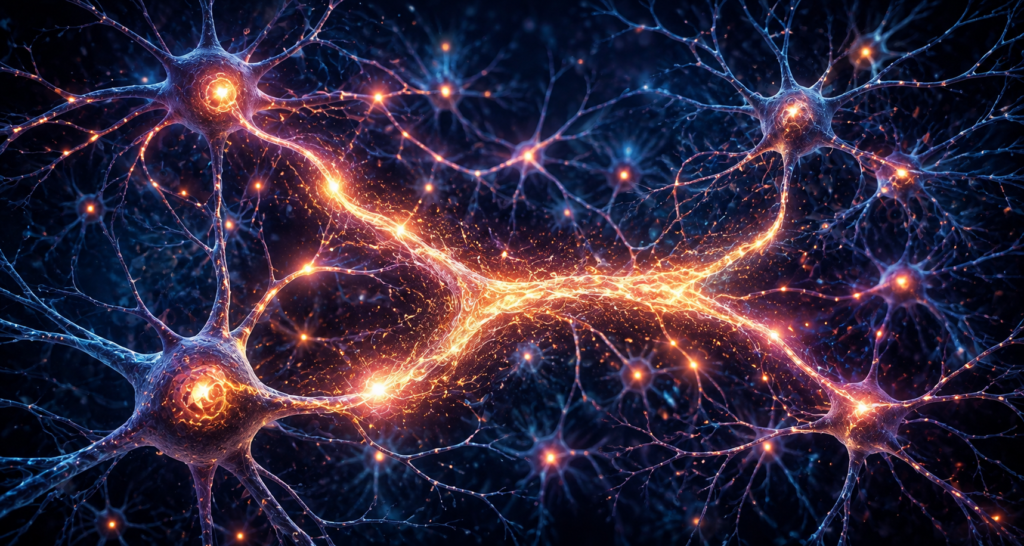
Repeated attention strengthens neural pathways.
What we repeatedly notice becomes easier to notice again.
Why this matters for flourishing
This idea connects beautifully with many positive psychology theories.
PERMA (Seligman)
Attention amplifies each pillar.
- Notice positive emotions.
- Invest attention in relationships.
- Become absorbed in engagement.
- Reflect on meaning.
- Celebrate accomplishment.
Without attention, these experiences often pass unnoticed.
Self-Determination Theory
When attention shifts away from external rewards towards intrinsic motivations—autonomy, competence and relatedness—well-being tends to increase.
Polyvagal Theory
Stephen Porges and Deb Dana might argue that our nervous system strongly influences where attention naturally goes.
When we feel unsafe, attention narrows towards:
- danger
- threat
- uncertainty
When we feel regulated and safe:
- curiosity expands
- creativity emerges
- connection becomes possible
- learning increases
A regulated nervous system allows us to direct attention intentionally rather than having attention hijacked by survival responses.
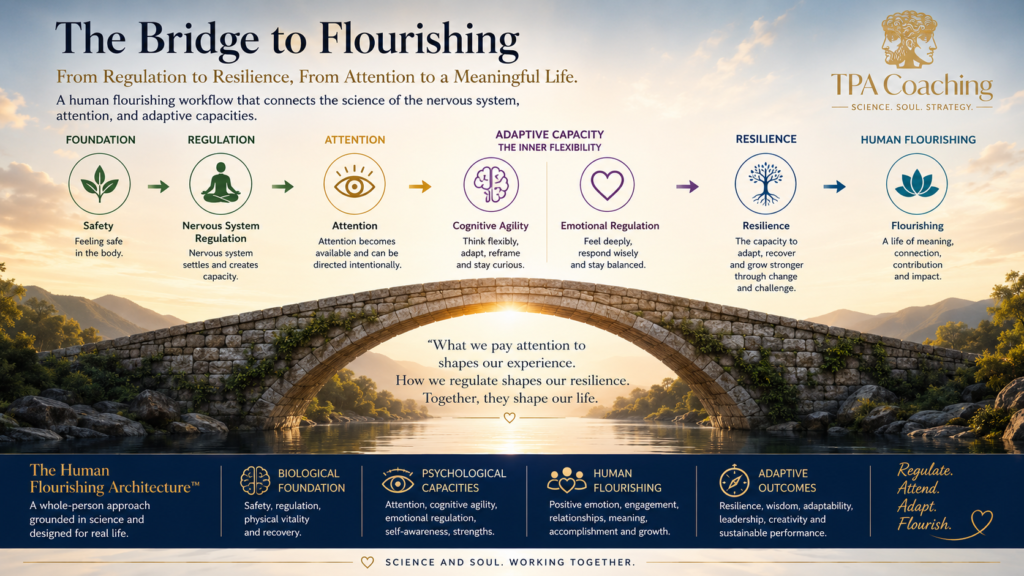
Links to the Human Flourishing Architecture™
Human flourishing begins with conscious attention.
Our wellbeing is not simply determined by circumstances, but by where we repeatedly invest the limited currency of our awareness.
Attention influences:
- Physical vitality — noticing sleep, movement, nutrition and bodily signals.
- Positive emotions — savouring moments of joy rather than rushing past them.
- Engagement — becoming fully absorbed in meaningful activity.
- Social connection — giving others genuine presence.
- Character strengths — recognising and using our best qualities.
- Meaning — attending to purpose rather than distraction.
- Accomplishment — focusing on progress instead of perfection.
Seen this way, attention becomes the thread that weaves together every element of flourishing.
A practical reflection
One of the simplest but most powerful questions inspired by Csikszentmihalyi is:
“Where did my attention go today?”
Not:
- What did I achieve?
- How busy was I?
- How productive was I?
But rather:
- What captured my attention?
- Did I choose it, or was it chosen for me?
- Did it leave me more alive, more connected and more purposeful?
Because, in the end, our lives are built not only from the events that happen to us, but from the moments to which we give our attention.
Conclusion
Attention is the gateway to flourishing. Our nervous system determines where attention naturally flows, our values determine where we choose to direct it, and over time those repeated acts of attention shape both our character and the quality of our lives.