

Beyond Longevity: The Four Pillars of Flourishing Ageing
An alternative perspective
The conversation around ageing is changing.
For decades, much of the focus has been on extending lifespan—living longer, preventing illness, and maintaining independence for as many years as possible. These are, of course, worthy goals.
But increasingly, I find myself asking a different question:
What if the goal is not simply to live longer, but to flourish longer?
Longevity alone is not the same as well-being.
Adding years to life is valuable, but adding life to those years may be even more important.
This idea sits at the heart of my emerging work around Human Flourishing Architecture—an attempt to bring together insights from positive psychology, character strengths, physical intelligence and well-being science into a practical framework for living well across the lifespan.
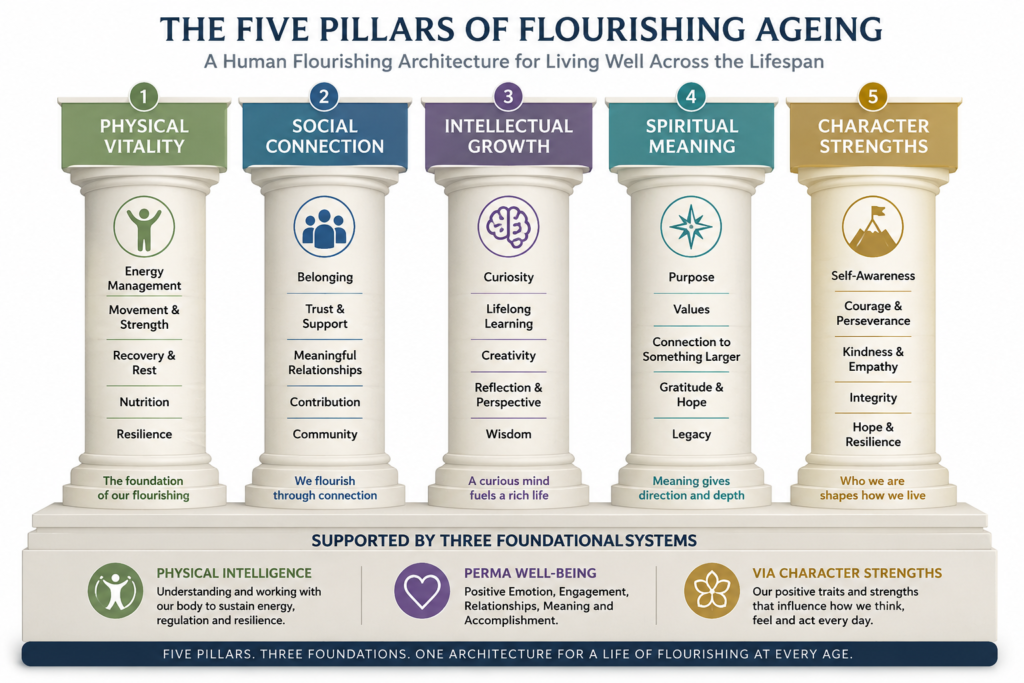
At its core, flourishing ageing appears to rest upon four interconnected pillars:
- Physical Vitality
- Social Connection
- Intellectual Growth
- Spiritual Meaning
These pillars are not separate domains to be managed independently. Rather, they form an integrated ecosystem that supports resilience, fulfilment and quality of life throughout our later years.
Pillar One: Physical Vitality
Physical health is often the starting point in discussions about successful ageing, and understandably so.
Our bodies provide the foundation upon which everything else is built.
Without sufficient energy, mobility and resilience, it becomes increasingly difficult to engage fully with life, maintain relationships, pursue goals or contribute to others.
Yet vitality is about much more than avoiding illness.
It involves developing what I have come to think of as Physical Intelligence—our ability to understand, interpret and respond effectively to the signals of the body.
This includes:
- Managing energy rather than simply managing time
- Prioritising recovery alongside performance
- Regulating stress effectively
- Maintaining strength, mobility and balance
- Developing sustainable daily habits
As we move through mid-life and beyond, the challenge is no longer maximising performance at all costs.
It becomes preserving capability, adaptability and vitality for the years ahead.
The question shifts from:
“How much can I achieve?”
to:
“How do I maintain the energy to enjoy the life I am creating?”
Pillar Two: Social Connection
One of the most consistent findings in well-being research is that relationships matter.
Not just for happiness, but for physical health, emotional resilience and even longevity itself.
Yet flourishing relationships are not measured by the number of contacts in our phone or followers on social media.
They are measured by:
- Belonging
- Trust
- Shared experience
- Emotional support
- Meaningful contribution
As careers progress and families evolve, many people discover that maintaining deep relationships requires greater intentionality than it did in earlier stages of life.
This is particularly true for men, who often discover that much of their social connection has been built around work rather than friendship.
The challenge becomes less about expanding networks and more about nurturing genuine connection.
Who are the people who truly know you?
Who would notice if you disappeared for a month?
Who helps you become more fully yourself?
These are the relationships that support flourishing.
Pillar Three: Intellectual Growth
A flourishing mind remains curious regardless of age.
Successful ageing is not simply about maintaining cognitive function.
It is about continuing to learn, adapt and grow.
Some of the most inspiring people I meet are not those who know the most.
They are those who remain open to learning.
They ask questions.
They challenge assumptions.
They explore new perspectives.
They continue to evolve.
In many ways, the first half of life is spent accumulating knowledge.
The second half offers the opportunity to transform knowledge into wisdom.
This pillar includes:
- Lifelong learning
- Creativity
- Reflection
- Curiosity
- Perspective-taking
The question evolves from:
“What do I know?”
to:
“What meaning have I made from what I know?”
Pillar Four: Spiritual Meaning
Perhaps the most overlooked pillar of flourishing ageing is meaning.
Not necessarily religion, although for many people faith remains an important source of support.
Rather, spirituality in its broadest sense concerns purpose, values, contribution and connection to something larger than ourselves.
As we age, many of life’s questions become less focused on achievement and more focused on significance.
What has my life stood for?
What contribution have I made?
What legacy will I leave?
What still matters most?
Research consistently suggests that individuals who maintain a strong sense of purpose tend to demonstrate greater resilience, stronger well-being and a more positive experience of ageing.
Meaning provides direction.
Values provide guidance.
Purpose provides motivation.
Together they create a compelling reason to continue growing, contributing and engaging with life.
Bringing the Pillars Together
What Human Flourishing Architecture adds to the conversation is the recognition that these four pillars are deeply interconnected.
Physical vitality supports engagement.
Social connection strengthens resilience.
Intellectual growth stimulates meaning.
Spiritual purpose inspires action.
Together they create the conditions for flourishing.
In my own thinking, these pillars are supported by three foundational systems:
PERMA provides the psychological architecture of well-being.
VIA Character Strengths provide the behavioural pathways through which flourishing is expressed.
Physical Intelligence provides the energy, regulation and embodied awareness needed to sustain it.
When these systems work together, flourishing becomes more than a theoretical concept.
It becomes a practical way of living.
A Different Question
Perhaps successful ageing is not about resisting growing older.
Perhaps it is about continuously strengthening the physical, social, intellectual and spiritual foundations that allow us to thrive throughout life.
The question is not:
“How long will I live?”
The more important question may be:
“How well will I live?”
Because longevity may add years to life.
But flourishing adds life to those years.
“The Fifth Pillar: Why Character Strengths Turn Healthy Ageing into Flourishing Ageing”
As I have continued to explore the science of successful ageing, I have become increasingly convinced that physical vitality, social connection, intellectual growth and spiritual meaning, whilst essential, are not the complete story.
The question that continues to intrigue me is this:
Why do some people seem able to sustain and strengthen these pillars throughout life while others struggle to do so?
The answer may lie in what positive psychologists refer to as character strengths.
Our strengths influence how we approach challenge, build relationships, pursue learning, recover from setbacks and find meaning in our experiences. They shape not only what we do, but how we do it.
Curiosity fuels intellectual growth.
Kindness and social intelligence deepen relationships.
Perseverance supports physical vitality.
Hope and gratitude strengthen meaning and purpose.
In many ways, character strengths are the hidden architecture beneath the visible pillars of flourishing.
They provide the behavioural pathways that transform intention into action and aspiration into reality.
This raises an intriguing possibility.
Perhaps successful ageing is not built upon four pillars alone.
Perhaps there is a fifth pillar—one that quietly supports all the others.
A pillar not of what we have, but of who we become.
That pillar is character.
“The first four pillars describe the life we seek to build. The fifth pillar describes the person capable of building it.
Take our Human Flourishing & Ageing Well Assessment™ Assessment