

The Human Flourishing Architecture™
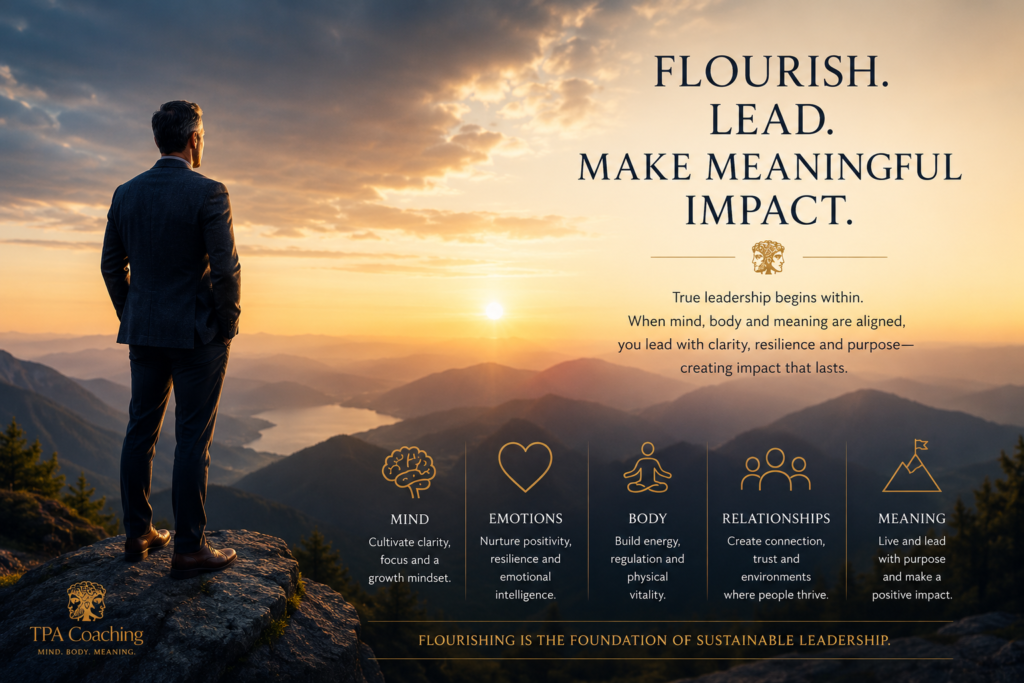
Integrating PERMA, VIA Character Strengths and Physical Intelligence for Sustainable Wellbeing, Leadership and Human Performance
Introduction
Over recent years, increasing attention has been given to wellbeing, resilience, leadership effectiveness, emotional intelligence and sustainable performance.
Yet despite the growing volume of research, many approaches still treat these areas separately.
Wellbeing is often discussed independently from leadership. Leadership is frequently separated from physiology. Performance is commonly prioritised without sufficient consideration of emotional regulation, meaning or human sustainability.
At the same time, many individuals continue to experience chronic stress, emotional exhaustion, reduced engagement, disconnection from purpose, declining resilience, burnout and fragmented wellbeing.
This raises an increasingly important question:
What actually creates sustainable human flourishing?
Through coaching, mentoring, supervision, leadership reflection, wellbeing practice and engagement with contemporary research, a broader pattern begins to emerge.
Human flourishing does not appear to result from a single intervention, mindset shift or productivity strategy.
Rather, flourishing emerges when multiple dimensions of human experience begin working together coherently.
This article explores an integrated model referred to as:
The Human Flourishing Architecture™
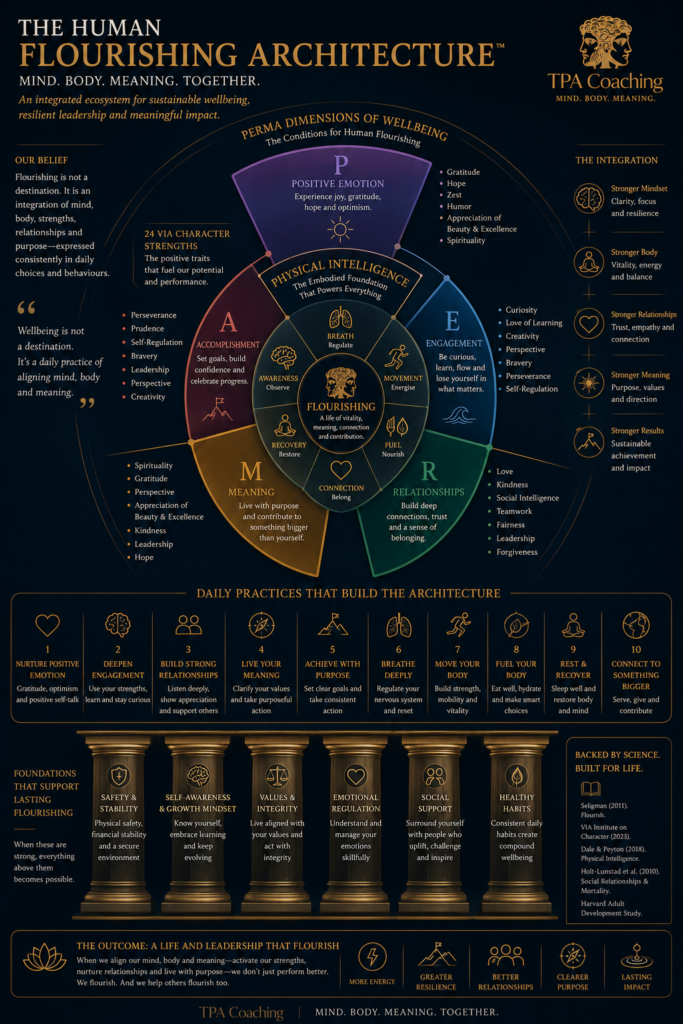
A framework that combines:
- Martin Seligman’s PERMA model of wellbeing
- The VIA Character Strengths framework
- Claire Dale and Patricia Peyton’s Physical Intelligence model
- Positive psychology research
- Behavioural science
- Nervous system regulation
- Reflective and strengths-based leadership approaches
Together, these create a more holistic understanding of sustainable wellbeing, resilient leadership and integrated human performance.
The Shift from Fragmented Wellbeing to Integrated Flourishing
Historically, wellbeing interventions often focused primarily on either:
- physical health,
- mental health,
- emotional resilience,
- or workplace engagement.
However, contemporary wellbeing science increasingly demonstrates that these domains are interconnected.
Psychological wellbeing affects physiological health. Physiology influences emotional regulation. Relationships shape resilience. Meaning influences motivation. Strengths influence engagement. Recovery affects cognitive performance.
Human beings do not operate in isolated categories.
We function as integrated systems.
This understanding sits at the heart of the Human Flourishing Architecture.
The model proposes that sustainable flourishing emerges through the alignment of:
- mindset
- physiology
- strengths
- behaviour
- relationships
- purpose
- emotional regulation
- recovery
- contribution
- and meaningful action
Rather than viewing flourishing as an abstract ideal, the framework positions it as:
An integrated daily practice.
PERMA: The Dimensions of Flourishing
One of the most influential models within positive psychology is Martin Seligman’s PERMA framework.
Seligman (2011) proposed that flourishing consists of five measurable dimensions of wellbeing:
P — Positive Emotion
Experiencing emotions such as joy, gratitude, hope and optimism.
E — Engagement
Becoming deeply absorbed in meaningful activity and experiencing flow.
R — Relationships
Developing supportive, trusting and emotionally meaningful relationships.
M — Meaning
Belonging to and serving something larger than oneself.
A — Accomplishment
Pursuing achievement, growth and purposeful goals.
Importantly, Seligman argued that flourishing extends beyond happiness alone.
True wellbeing involves the interaction of emotional, relational, psychological and purposeful dimensions.
PERMA therefore provides a valuable architecture for understanding human flourishing.
However, while PERMA explains many dimensions of wellbeing, it leaves important questions unanswered:
- What enables people to access flourishing consistently?
- Why do some individuals struggle to express resilience or emotional regulation despite understanding wellbeing concepts intellectually?
- How does physiology influence psychological functioning?
- What human capacities help activate flourishing in daily life?
This is where Physical Intelligence and VIA Character Strengths become highly complementary.
Physical Intelligence: The Embodied Foundation of Flourishing
Claire Dale and Patricia Peyton’s concept of Physical Intelligence (2018) introduces a critical insight:
The body shapes the mind.
Physical Intelligence proposes that physiology directly influences:
- emotional regulation
- stress responses
- resilience
- leadership presence
- focus
- confidence
- adaptability
- communication
- and performance
In many professional environments, performance has traditionally been approached cognitively.
Yet neuroscience and behavioural science increasingly demonstrate that human functioning is deeply embodied.
How we breathe influences the nervous system. Movement affects cognition and mood. Sleep impacts emotional stability. Recovery influences resilience. Nutrition shapes energy and focus.
The Human Flourishing Architecture therefore positions Physical Intelligence as:
The physiological foundation that powers flourishing.
Within the framework, six core embodied domains become particularly important:
Awareness
Developing awareness of emotional, physical and energetic states.
Breath
Using breathing intentionally to regulate emotional and nervous-system states.
Movement
Supporting vitality, cognition and emotional wellbeing through physical movement.
Recovery
Prioritising sleep, rest and restoration.
Fuel
Nourishing the body through hydration, nutrition and sustainable habits.
Connection
Recognising the importance of social, environmental and embodied connection.
The significance of this integration is profound.
It suggests that flourishing is not purely psychological.
It is embodied.
VIA Character Strengths: The Human Capacities Behind Flourishing
A further dimension emerges through the VIA Character Strengths framework developed by Peterson and Seligman (2004).
The VIA Classification identified 24 universal character strengths organised under six broad virtues:
- Wisdom
- Courage
- Humanity
- Justice
- Temperance
- Transcendence
The 24 strengths include qualities such as:
- curiosity
- kindness
- perseverance
- gratitude
- creativity
- bravery
- perspective
- hope
- leadership
- humour
- self-regulation
- social intelligence
The significance of VIA strengths lies in their practical expression.
The framework demonstrates that flourishing is not merely something people experience.
It is also something people actively express through their behaviours, attitudes and relationships.
Character strengths therefore become:
The behavioural capacities that activate flourishing.
For example:
- Gratitude supports Positive Emotion
- Curiosity supports Engagement
- Kindness supports Relationships
- Hope supports Meaning
- Perseverance supports Accomplishment
This creates a natural integration between PERMA and VIA.
Mapping VIA Strengths Across PERMA
The Human Flourishing Architecture positions VIA strengths as dynamic contributors to each PERMA domain.
| Positive Emotions | Engagement | Relationships | Meaning | Accomplishment |
| Gratitude Hope Zest Humour Appreciation of Beauty and Excellence Spirituality |
Curiosity Creativity Love of Learning Perspective Perseverance Self-Regulation |
Love Kindness Social Intelligence Teamwork Fairness Leadership Forgiveness |
Spirituality Gratitude Perspective Leadership Appreciation of Beauty and Excellence Hope |
Perseverance Prudence Self-Regulation Bravery Leadership Creativity |
The Integration Point: Flourishing as a Living Ecosystem
The Human Flourishing Architecture proposes that flourishing emerges when:
PERMA + VIA + Physical Intelligence work together.
This creates a living ecosystem rather than a linear model.
The embodied foundation that enables sustainable expression.
Together, the framework suggests that flourishing emerges through alignment between:
- body
- mind
- strengths
- values
- relationships
- behaviours
- recovery
- meaning
- and purposeful action
This integrated perspective is particularly relevant within leadership and organisational contexts.
Increasingly, organisations are recognising that:
- burnout undermines performance
- emotional dysregulation impacts culture
- chronic stress reduces creativity and engagement
- psychological safety affects innovation
- and sustainable performance requires human sustainability
As a result, flourishing becomes more than personal wellbeing.
It becomes a leadership capability.
Leadership, Resilience and Human Sustainability
Traditional leadership models frequently prioritised authority, productivity, competence, strategic execution and technical performance.
However, contemporary leadership increasingly requires emotional intelligence, adaptability, resilience, relational depth, self-awareness, meaning and nervous-system regulation.
The Human Flourishing Architecture therefore positions leadership maturity as an integrated developmental process.
Sustainable leadership requires:
- regulated physiology
- aligned values
- strengths awareness
- reflective capability
- emotional balance
- healthy relationships
- and purposeful contribution
In this sense, flourishing is not separate from leadership.
Flourishing enables leadership.
The Future of Wellbeing and Leadership
The growing integration between positive psychology, behavioural science, leadership development and embodied wellbeing suggests an important shift.
The future of sustainable performance is unlikely to be driven solely by productivity.
Instead, future-focused leadership and wellbeing approaches will increasingly involve:
- integrated resilience
- strengths-based development
- emotional regulation
- nervous-system awareness
- relational intelligence
- meaningful work
- sustainable energy
- and human-centred performance
The Human Flourishing Architecture reflects this evolution.
It proposes that flourishing is not achieved through perfection, constant positivity or relentless performance.
Rather, flourishing emerges through the ongoing integration of:
mind, body and meaning.
Conclusion
Perhaps one of the most important insights emerging from contemporary wellbeing science is that flourishing is not a destination.
It is not a fixed state to achieve once and maintain permanently.
Instead, flourishing is dynamic.
That has changed:
- how I coach,
- how I think about leadership,
- how I approach wellbeing,
- and even how I structure my own daily habits.
References
Dale, C., & Peyton, P. (2018). Physical Intelligence: Harness Your Body’s Untapped Intelligence to Achieve More, Stress Less and Live More Happily. Simon & Schuster.
Fredrickson, B. L. (2001). The role of positive emotions in positive psychology: The broaden-and-build theory of positive emotions. American Psychologist, 56(3), 218–226.
Holt-Lunstad, J., Smith, T. B., & Layton, J. B. (2010). Social relationships and mortality risk: A meta-analytic review. PLoS Medicine, 7(7).
Kabat-Zinn, J. (2003). Mindfulness-based interventions in context: Past, present, and future. Clinical Psychology: Science and Practice, 10(2), 144–156.
Peterson, C., & Seligman, M. E. P. (2004). Character Strengths and Virtues: A Handbook and Classification. Oxford University Press.
Seligman, M. E. P. (2011). Flourish: A Visionary New Understanding of Happiness and Well-being. Free Press.
VIA Institute on Character. (2023). VIA Character Strengths Survey and Research. https://www.viacharacter.org
World Health Organization. (2022). Mental health and wellbeing frameworks.